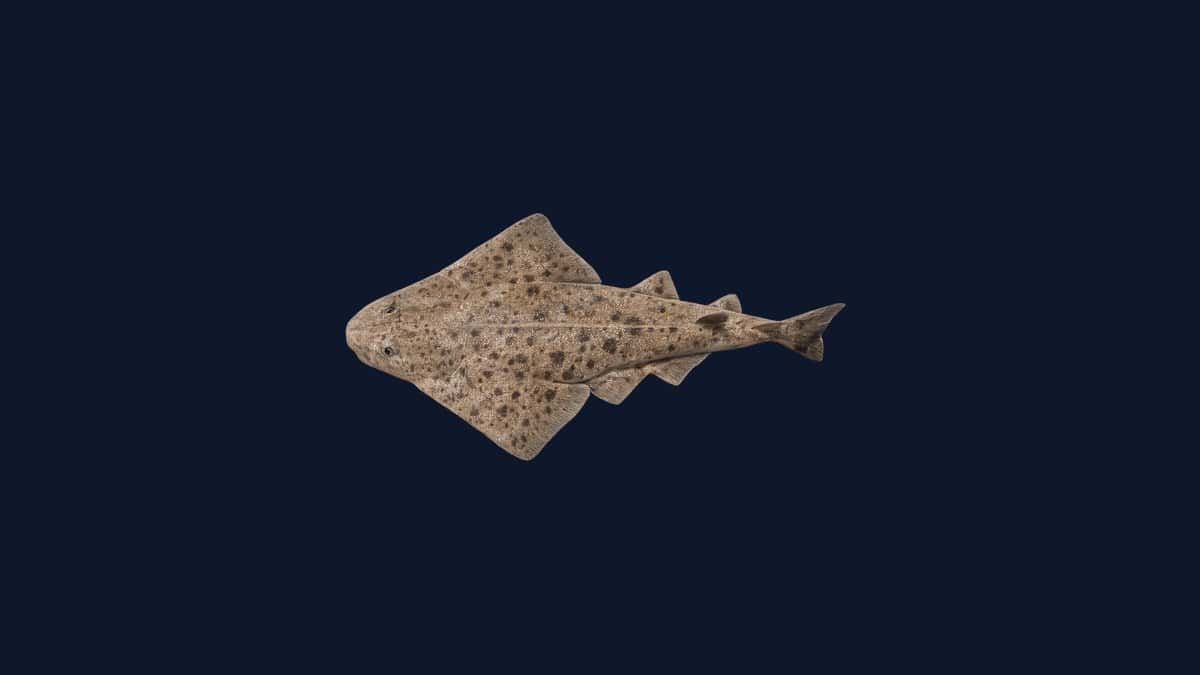
Pacific angel shark studio illustration — flattened shark with broad pectoral fins spread like wings, mottled gray-brown dorsal surface, against a black background.
All Species

Pacific Angel Shark

Squatina californica

In Season Now5 lbs – 30+ lbs

A flattened ambush predator that buries in sandy seafloor and waits. Almost never targeted — most encounters are bycatch on halibut or bass trips. The commercial fishery is essentially closed; recreational take is allowed but uncommon.

Illustration: Fish City

About Pacific Angel Shark

Pacific angel sharks are the unusual outlier in California's shark lineup — flattened, bottom-dwelling ambush predators that look like they're wearing a ray's body. They're common on sandy and muddy nearshore bottoms throughout California but are almost never deliberately targeted by recreational anglers.

FishBase records maximum length at 152 cm (about 5 ft) with typical adults in the 90–140 cm range. IUCN lists the Pacific angel shark as Vulnerable (assessed September 2024), noting the California population is likely recovering since the 1994 inshore gillnet ban but still faces threats from incidental capture and habitat disturbance.

The commercial gillnet fishery that once targeted angel sharks around the Channel Islands and Santa Barbara–Ventura coast was effectively ended by Proposition 132 in 1994, which banned gillnets and trammel nets within 3 nautical miles of the mainland California coast. That ban, not a direct species prohibition, is what shut down the fishery. Recreational take remains allowed but is rarely pursued.

Do not confuse Pacific angel shark (Squatina californica) with the common angel shark (Squatina squatina) of the Atlantic and Mediterranean, which is Critically Endangered. They are separate species with separate conservation statuses.

How to Catch

Angel sharks are almost exclusively encountered as bycatch on halibut and bass trips over sandy bottoms. They react to the same presentations as California halibut — live anchovies, sardines, and swimbaits worked near the bottom.

The predation strategy is pure ambush. Angel sharks bury themselves in sand with only their eyes visible, wait for a fish to pass within striking distance, and explode upward in a fraction of a second to engulf the prey. Your bait landing near a buried fish is what triggers the bite — it's not about presentation finesse, it's about landing in the right spot.

There's no standard targeted technique because almost nobody targets them. If you want to encounter them deliberately, fish the same sandy bottom areas you'd target for California halibut (Mission Bay, Huntington Flats, Santa Monica Bay sand), but don't be disappointed when you get halibut instead.

Regulations and Handling

Recreational take is allowed in California. There is no specific bag limit or minimum size in the current regulations. The key restrictions are on commercial gear (gillnets prohibited nearshore), not on recreational angling.

Given the species' Vulnerable status and declining global population, the conservation-minded approach is catch-and-release. Handle with care: support the body, keep horizontal, and return to water immediately. Never lift an angel shark vertically by the tail — their flat body is not designed for that.

Common Mistakes

  • Assuming they're prohibited. They're not — many anglers believe angel sharks are fully protected in California. The commercial gillnet ban is often misunderstood as a species-level protection. Recreational take is legal; it's just unusual.
  • Grabbing near the head. Angel sharks have a short striking range but a fast, powerful bite. Keep hands away from the head and use a towel or gloves near the mouth.
  • Keeping them out of water too long. Like all sharks, prolonged air exposure stresses them. If you're releasing, get them back in the water quickly — less than 30 seconds out of water is the guideline for proper handling.


Where to Catch Pacific Angel Shark in California

  • Sandy and muddy nearshore bottoms throughout SoCal
  • Continental shelf sandy areas, 10–50 ft
  • Sandy zones adjacent to kelp beds
  • Bay mouths and nearshore sand flats
  • Historically common around Channel Islands and Santa Barbara–Ventura area

Conditions & Habitat

Water Temp

55–72°F; prefer 60–65°F in central and southern California

Typical Depth

3–150 ft; bury in sandy bottom, most common in 10–50 ft

Diet

Halibut, croakers, squid, crustaceans — ambush predator that lies camouflaged and strikes upward

How to Catch Pacific Angel Shark

Techniques

  • Not a targeted species — typically encountered as bycatch on halibut and bass trips
  • Bottom fishing with live anchovy or sardine on sandy bottom
  • Cut bait (squid, mackerel) drifted near bottom
  • Swimbait worked along sandy floor for other flatfish species

Lures & Baits

  • Live anchovy on a bottom rig (bycatch — not targeted)
  • Squid strip on a dropper loop rig (bycatch — not targeted)

Line & Leader

Standard halibut or sand bass light tackle — 20–30 lb braid, 15–20 lb fluorocarbon leader. Angel sharks don't require specialized gear; they're almost always bycatch.

Rod & Reel Combos

  • Whatever light conventional or spinning setup you're using for halibut — standard bycatch

Regulations

No recreational bag limit or size minimum specified in California regulations for Pacific angel shark. Commercial take via gillnet and trammel net was effectively closed in 1994 by the inshore net ban (within 3 miles of mainland coast). Recreational take is allowed but rarely pursued. No active prohibited status for recreational anglers. Always verify current CDFW regulations. If encountered and released, handle gently and return to water immediately.

As of April 20, 2026 — CDFW source

Did You Know?

Pacific angel sharks can strike in under 0.1 seconds — one of the fastest predatory strikes recorded in any shark species. They lie completely still, camouflaged against the sandy seafloor, with only their eyes and spiracles (breathing holes on top of the head) exposed. When a California halibut or croaker swims within 10–15 cm, the shark erupts upward and forward, engulfing the prey before it can react.

Boats Known for Pacific Angel Shark

Charter boats with a track record on this species.

Halibut and bass party boats (bycatch)

Multiple SoCal landings

Not targeted — shows up on halibut trips over sandy bottom

Book a Pacific Angel Shark Charter

Find charter boats targeting Pacific Angel Shark at these California landings:

Frequently Asked Questions

Not under a full take prohibition for recreational anglers as of 2026. Commercial gillnet and trammel net take within 3 miles of the California mainland coast was banned in 1994 (Prop 132), which effectively shut down the targeted commercial fishery in prime angel shark habitat. Recreational take is allowed but angel sharks are almost never deliberately targeted. The IUCN lists Pacific angel shark as Vulnerable (2024 assessment). If you catch one on a halibut trip, you can legally retain it, but most anglers release them.

Sources

Ready to Find the Bite?

Join thousands of California anglers using Fish City for real-time fish counts, reports, and charter data.

Download on the App StoreGet it on Google Play

Free — no subscription required