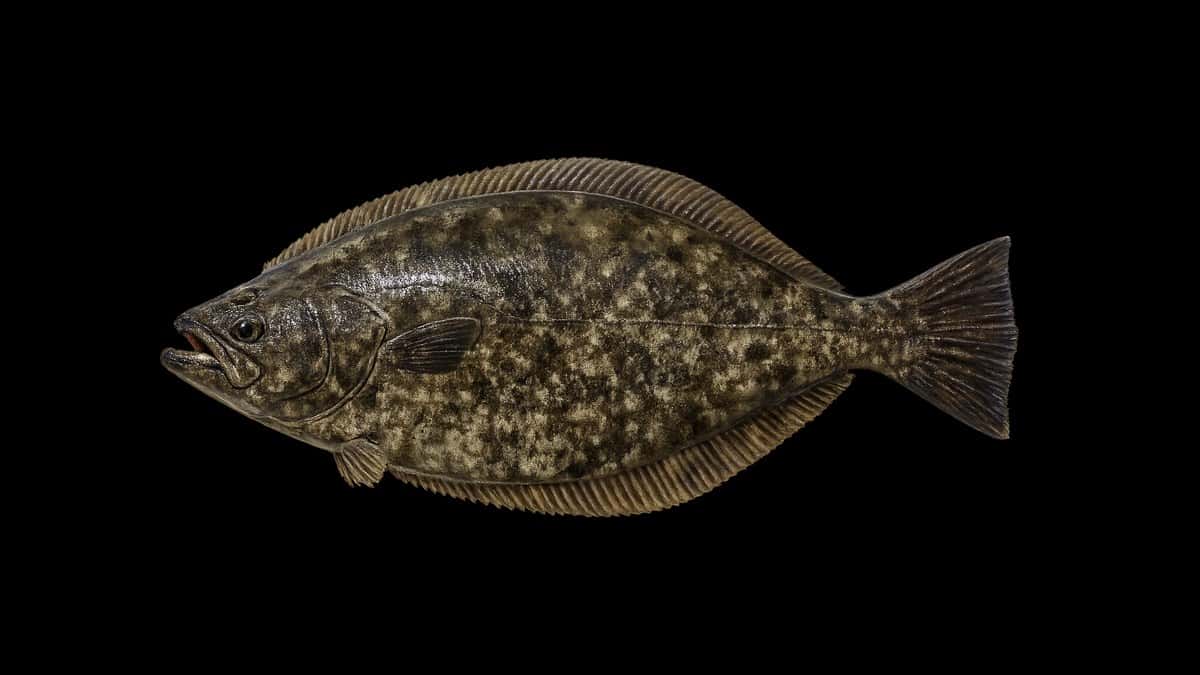
About California Halibut
California halibut are the shore-accessible trophy fish of SoCal. A 20-pounder is realistic from a half-day bay boat, a 30-pounder is a lifetime catch, and they eat like nothing else on ice.
Don't confuse them with Pacific halibut — that's a different species that lives in Alaska and Washington, grows to 300+ pounds, and doesn't live here. The California state record is 67 lb 4 oz (Francisco Rivera, Santa Rosa Island, 2011); average SoCal keepers run 3–10 lbs.
How to Catch
This is patient, ambush-focused fishing. Halibut bury themselves in sand with only their eyes exposed, wait for a baitfish to swim over, and explode up to inhale it. Your job is to drag something that looks like a confused baitfish past their window.
The private-boat pattern is swimbait on a light jig head worked along the bottom. Big Hammer 5-inch in pearl white or smelt, 1 oz head, slow retrieve with occasional twitches. Cast, let it hit bottom, two cranks, pause, two cranks. The bite is a thump followed by weight — don't swing, reel down and set.
On a live-bait boat, nose-hook an anchovy or sardine on a Carolina rig with a sliding egg sinker and let it swim along the bottom in the current. The bite is subtle — pay attention to the rod tip going soft.
The trap rig — a primary hook at the bait's nose and a stinger hook pinned into its tail — is the answer for short-biters. Halibut often grab a bait tail-first and spit the hook; the stinger fixes that.
Eating Profile
The best-eating fish in SoCal in the running with white seabass. Delicate, sweet, snow-white flesh that works for literally any preparation — grilled, broiled, pan-fried, sashimi, ceviche. A single 15-pounder gives you 4 dinners. Don't overcook; halibut dries out fast.
Seafood Watch rates California halibut from U.S. hook-and-line/handline gear as a "Best Choice" (green rating), with set gillnet-caught fish listed as "Good Alternative." Stocks are healthy in Southern California and recreational pressure is managed.
Common Mistakes
- Setting the hook too early. Halibut tap, chew, then swallow. A three-second count before setting lands twice as many fish as a reflex hookset.
- Fishing slack water. No current = no drift = no bait presentation = no fish. Fish incoming/outgoing tides; skip the top and bottom of the tide.
- Ignoring structure edges. Halibut set up on the edges of sand-to-structure transitions — where sand meets rock, or a sand channel cuts through a flat. Not in open open sand.
- Too much weight. A 4 oz sinker thuds to the bottom and drags. A 1 oz jig head flutters and looks like a real baitfish. Use the lightest weight the current allows.
Month-by-Month
- Jan–Feb: Slow. Fish deeper and scattered. Winter halibut possible but low-percentage.
- Mar–Apr: Bite picks up as water warms. Early-spring fish are often the biggest of the year — pre-spawn bulls moving into the flats.
- May–Jul: Peak window. Spawning fish on sandy flats, Huntington and Santa Monica Bay stacked. Swimbait and anchovy both produce.
- Aug–Sep: Steady action as water holds. Slightly smaller average fish, more numbers.
- Oct: Good fall bite before fish drop deeper.
- Nov–Dec: Fish back to 80+ ft, scattered. Private boaters can pick them up drifting; party boats shift to bass and rockfish.