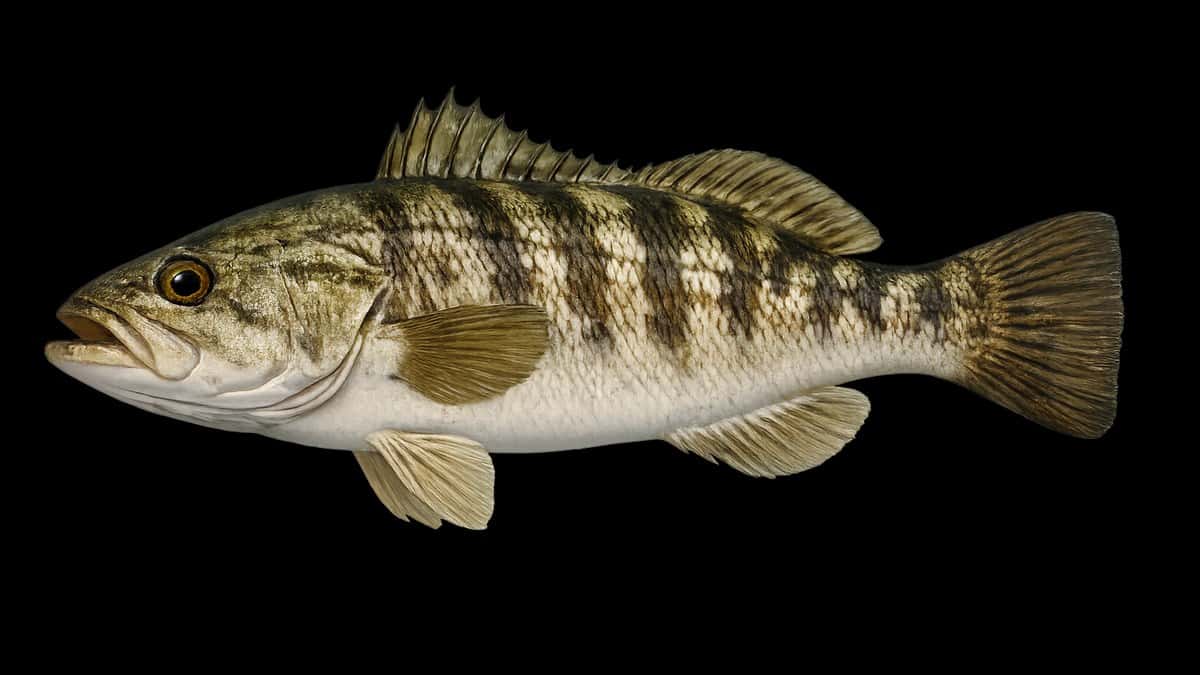
About Calico Bass
If you've fished SoCal kelp, you've fished for calicos — probably without realizing they're the crown jewel of the nearshore fishery. Year-round bite, aggressive strikes, explosive kelp-edge boils. Calicos (officially Kelp Bass, Paralabrax clathratus) are why half-day boats exist.
Most fish run 2–5 pounds, but a La Jolla kelp bed in September will give up 7+ pounders to anglers who know what they're doing. The California state record is 14 lb 7 oz (C.O. Taylor, San Clemente Island, 1958) — a mark that has stood for nearly 70 years and is also the IGFA all-tackle world record for the species.
How to Catch
You're fishing a 3-dimensional ambush habitat. That changes everything.
The go-to technique is a boot-tail swimbait on a 3/4–3 oz jig head, cast to the kelp edge and retrieved slow through the shade line. Calicos sit in the canopy shadows and ambush anything that swims past. Let the lure sink on slack line, give it two slow cranks, pause, two more cranks. The bite is violent — set hard, crank fast, pull their heads out of the kelp before they break you off.
Live bait works too, especially when the fish are scattered. Collar-hook a sardine so it swims into the kelp — calicos hate an intruder in their shade.
Heavier line than you think. Calicos bury in kelp the second they're hooked. 50–65 lb braid is standard; 30–40 lb fluoro leader unless you're fishing dirty structure, then tie direct.
Eating Profile
Mild, flaky, white flesh — somewhere between a halibut and a lingcod. Pan-fried with lemon and capers, or cubed into fish tacos with a cilantro-lime crema. Seafood Watch rates CA hook-and-line calicos as a "Good Alternative." Legal size is 14 in, but consider releasing anything over 7 lbs — a 7-pound calico is ~15 years old and is among the productive breeders the population depends on.
Common Mistakes
- Too-light line. You hook a 4-pounder on 20 lb mono, it turns for the kelp, you lose it. Trade finesse for stopping power.
- Fishing the wrong edge. Calicos sit in shadow. If the sun's behind you, you're casting to the lit side of the kelp — no fish. Move around.
- Setting the hook like a trout angler. Cross their eyes, then crank. You're not trying to play the fish — you're trying to drag it out of a jungle gym.
- Ignoring the thermocline. In May–June water, calicos can be at 80 ft even when surface temp looks right. Drop down with a heavier jig head.
Month-by-Month
- Jan–Mar: Deep and slow. 60–80 ft off the outer kelp. Heavy jig heads, slow retrieve.
- Apr–May: Fish start climbing as water warms. Mid-depth kelp edges 30–60 ft.
- Jun–Sep: Peak. Surface to 40 ft. Topwater poppers work at dawn, swimbaits all day.
- Oct–Nov: Still good, fish pushing deeper as water cools. Return to mid-column tactics.
- Dec: Slow but catchable. Reward the effort with a quiet boat and nobody to split the kelp with.