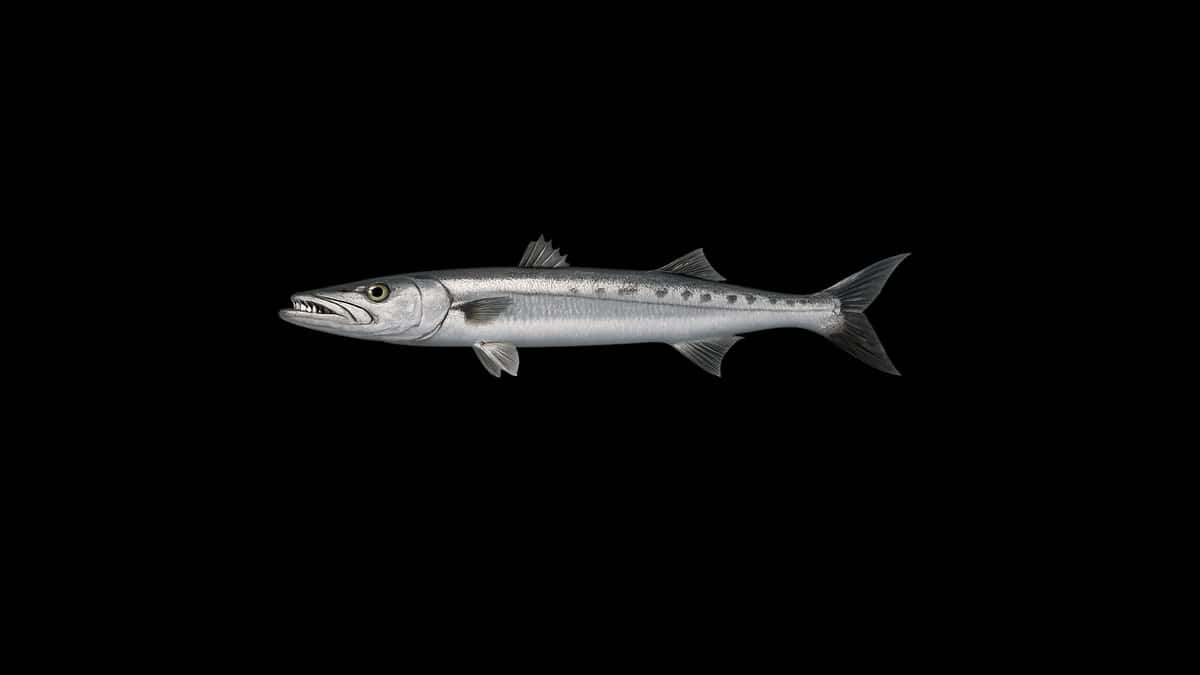
About California Barracuda
California barracuda are the kelp-line staple of SoCal spring and summer. They're the fish that taught half of San Diego to throw surface iron — cheap, catchable, and explosive on the strike.
They're not the great barracuda of Florida and the Caribbean. Pacific (California) barracuda top out around 15 lbs, average 3 to 6 lbs in typical catches, and rarely cross 36 inches. The big ones are females. Great barracuda grow to 100+ lbs and carry ciguatera in some tropical waters; California barracuda don't and are safe eating.
They migrate up from Baja each spring when water crosses 64°F, and they're gone by October when it cools back down. During the peak weeks (May through July), the La Jolla kelp and Coronado Islands can produce 15-fish days on a half-day boat. Most will be pencils; the keepers are the prize.
How to Catch
Surface iron and spoons dominate.
The classic rig is a Krocodile spoon or Salas surface iron cast past a kelp edge and retrieved fast. Fast = barracuda strike. Slow = they ignore you. The action of the lure should imitate a panicked anchovy skipping away from predators. Chrome and blue/chrome are the most productive colors; scrambled egg (yellow) catches selective fish.
Topwater plugs are the most fun. A Yo-Zuri Sashimi Bull or Heddon Zara Spook walked across the surface with a rod-twitch retrieve produces violent strikes and 3-ft jumps. When barracuda are boiling on bait, throw into the boil and hold on.
Live bait works when the school is deeper or finicky. Fly-line an anchovy or smelt with a 1/0 circle, 20-lb fluoro, no weight — cast it at the kelp edge and let it swim. Expect short strikes (the fish grabs the tail and spits); a trap rig with a tail stinger solves that.
Distance matters. Barracuda spook off boat wake; the captain will position the boat 40 to 60 feet off the kelp and the long casters fill coolers while the short casters watch. Practice your cast; a 7.5- to 8-ft medium spinning rod with a 4000-size reel throws a 1.5-oz iron 80+ yards.
Eating Profile
Underrated. Mild, flaky, white — grills well with lemon and olive oil, makes decent fish tacos, and fries great. Not as premium as yellowtail or white seabass, but better than most SoCal anglers give it credit for. The key is handling: bleed the fish immediately (gill cut) and ice it hard. Barracuda warms up fast and the flesh turns mushy if you leave it on deck.
A 5-lb keeper gives you about 2 lbs of clean fillets. Skin it before cooking — the skin is strong-flavored and not great.
Seafood Watch rates Pacific barracuda as Good Alternative. The stock is healthy and the hook-and-line fishery is low-impact.
Common Mistakes
- Slow retrieve. Barracuda hit fast-moving lures. If you're not catching, speed up until you are.
- Wire leader. Doesn't help for California barracuda and kills your bite count. Use 20–30 lb fluorocarbon; add a 6-in 40 lb bite tippet only if you're consistently getting cut.
- Keeping pencils. Anything under 28 inches is illegal. Carry a rail ruler or use the deckhand's. Photograph and release undersized fish; a quick release is easy.
- Skipping the bleed. Every barracuda you don't bleed gets worse eating. A 30-second gill cut doubles the fillet quality.
- Fishing dead kelp. Barracuda key on bait. A kelp paddy with no mackerel flashes or no bird activity won't produce. Look for activity — birds, boils, flashes — and fish only where the bait is.
Month-by-Month
- Jan–Mar: Gone south to Baja. A few scattered fish in warm winter years, but low-percentage.
- Apr: First schools push into SoCal as water warms. Early-season fish are the biggest of the year.
- May–Jul: Peak. Kelp-line action at La Jolla, Point Loma, Dana Point, Catalina. 28+ inch keepers mixed with pencils. Surface iron and topwater producing.
- Aug–Sep: Steady action, more pencils than keepers. Water is warmest; fish mostly shallow.
- Oct: Fish starting to move south as water cools. Bite winds down.
- Nov–Dec: Gone. See you next April.