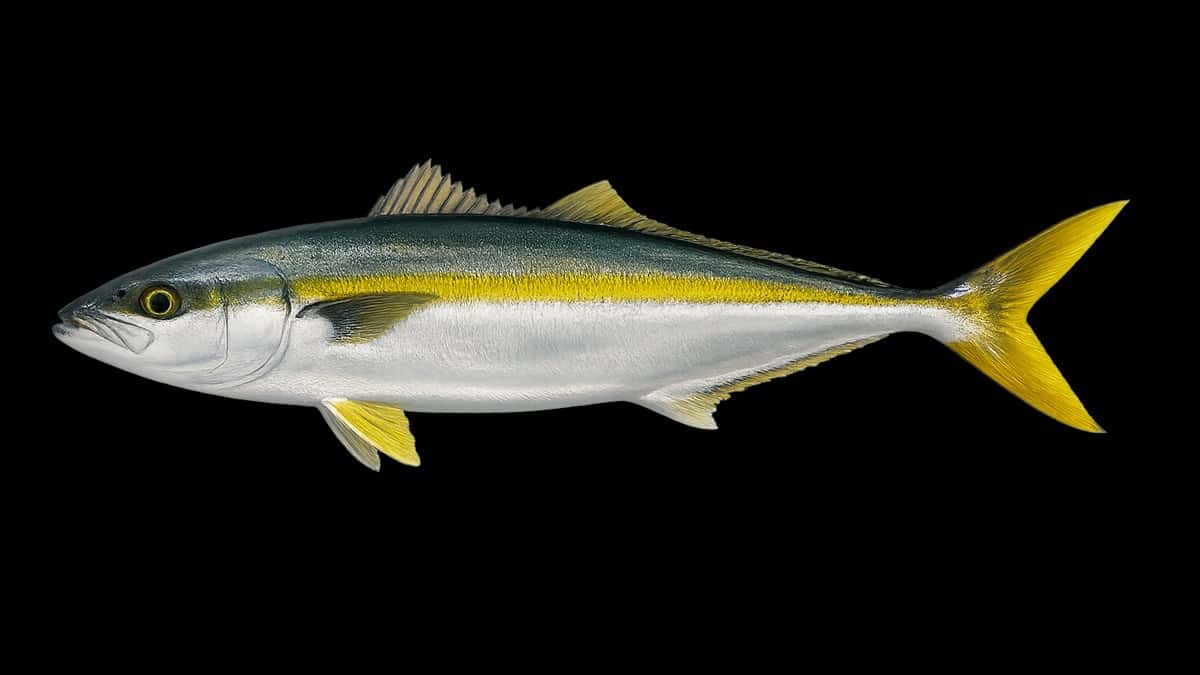
Yellowtail studio illustration — sleek gold-and-silver jack profile with distinctive yellow tail fin against a light background.
All Species

Yellowtail

Seriola lalandi

Updated · Published

In Season Now5 lbs – 40+ lbs

SoCal's hardest-running jack. Surface iron at the Coronados, yo-yo jig on the meter, live bait on the kelp — the fish that built the San Diego fleet.

Illustration: Fish City

Yellowtail Season California

California yellowtail run year-round at the Coronado Islands, with a peak from March through October. Local kelp beds at La Jolla and Catalina fire May through September. Winter fish exist — they go deep, so drop to yo-yo iron or flat-falls.

Yellowtail Size Limit California

California sets a 24-inch fork-length minimum on yellowtail. Daily bag limit is 10 fish; up to 5 of those may be undersized (under 24 inches FL). Federal EEZ rules apply beyond 3 miles. Always verify current CDFW regs before your trip.

Where to Catch Yellowtail

Coronado Islands are the #1 SoCal ground — year-round and accessible on a 3/4-day out of San Diego. La Jolla and Point Loma kelp beds fire May through September. San Clemente Island holds big mossbacks in fall. Offshore kelp paddies 10–40 miles out also hold schools on warm-water years.

How to Catch Yellowtail

Three techniques cover 95% of SoCal yellowtail fishing. Surface iron: cast a Salas 7X past a boil and rip it back. Yo-yo iron: drop a Tady 9 to structure and retrieve high-speed. Fly-line live bait: nose-hook a sardine on 25 lb mono and let it swim into the kelp. Minimum tackle is 40 lb mono or 65 lb braid with a 25–40 lb fluoro leader.

About Yellowtail

Ask a San Diego charter captain which fish built their business and the answer isn't bluefin — it's yellowtail. Year-round at the Coronados, hard-running, smart, and delicious. A 25-lb yellowtail on 40-lb tackle is the SoCal half-day gold standard.

Seriola lalandi is technically a jack, not a tuna. Doesn't matter. They fight harder per pound than most tuna.

Fish range from 5-lb "firecracker" schoolies at the local kelp (legal as part of the 5-fish sub-limit under 24 inches FL) to 40+ lb "mossbacks" at San Clemente Island. The IGFA all-tackle world record for California yellowtail is 109 lb 2 oz, caught at Cedros Island in 2000. Most quality fish come in the 18-25 lb range — which, it turns out, is a perfect size for homerun table fare.

How to Catch

Three techniques cover 95% of yellowtail fishing in SoCal.

Surface iron. When you see a boil, grab a Salas 7X Light in blue/white or scrambled egg and cast past the boil, then rip it back with a wide sweeping retrieve. The side-to-side wobble triggers the strike. Long rod (8-9 ft), long cast, star-drag conventional reel — braid to a 40 lb fluoro leader.

Yo-yo iron. Fish are deep, you see them on the meter at 80 ft, this is your move. Tady 9 in scrambled egg, drop to bottom, high-speed retrieve straight up. The bite happens on the lift. 80 lb braid, 60 lb leader, no light gear.

Fly-line live bait. When the fish are scattered or pressured, a nose-hooked sardine on 25 lb mono will out-fish any jig. Let the bait swim into the kelp or down into the boil. A good live sardine is worth three bad jigs.

Leave the bass gear. You will lose fish on 20 lb mono.

Eating Profile

Yellowtail is the SoCal sashimi fish. Dense, mildly sweet, clean flavor. Bleed fish on deck, ice immediately — sashimi quality requires it. Also excellent as yellowtail crudo, ceviche, grilled with teriyaki glaze, or on the grill as steaks. Seafood Watch rates California hook-and-line yellowtail as a "Good Alternative."

A 20 lb yellowtail yields 10 lbs of filets. Freezer for months. This is why you book the charter.

Common Mistakes

  • Skipping the iron rod. You can't fish surface boils with a bass setup. If you're fishing the Coronados, bring an iron stick or rent one from the landing.
  • Light fluoro. 20 lb fluoro on a 25 lb yellowtail running for structure? You lose. Use 40-60 lb for iron, 25-30 lb for fly-line.
  • Setting the hook too fast on live bait. Let them eat. Count to three, then lean into them. A premature hook-set pulls the bait out of their mouth.
  • Ignoring the passport rule. Showing up for a Coronados trip without a passport card means you sit at the dock while your boat leaves. Verify before the night-before trip.

Month-by-Month

  • Jan–Feb: Deep. Yo-yo irons and flat-falls at the Coronados. Local kelp is slow.
  • Mar–Apr: Fish begin climbing. Coronados fires. First local kelp biters show.
  • May–Jun: La Jolla kelp wakes up. Coronados 3/4-day trips are a reliable home run.
  • Jul–Sep: Peak everywhere. Local kelp, offshore paddies, Coronados — it's on.
  • Oct: Still strong. Big fish come from San Clemente Island.
  • Nov–Dec: Cooling. Fish push deeper. Yo-yo dominates.

Where to Catch Yellowtail in California

  • Coronado Islands (Mexican waters)
  • La Jolla kelp beds
  • Catalina Island leeward side
  • San Clemente Island
  • Offshore kelp paddies 10–40 miles out
  • Santa Barbara oil rig structure
  • Point Loma / Coronado kelp edge
  • 177 Spot and nearby SD banks

Conditions & Habitat

Water Temp

64–75°F (optimal 70–72°F); fish go deeper below 64°F

Typical Depth

Surface to 180 ft; most action 20–80 ft around kelp and structure

Diet

Sardines, anchovies, mackerel, squid, crabs, smelt

How to Catch Yellowtail

Techniques

  • Surface iron (Salas 6X/7X, Tady 45) cast past boils
  • Yo-yo iron (Tady 9) high-speed from bottom
  • Fly-lined live sardine or anchovy on 25–30 lb mono
  • Flat-fall jig (Shimano Butterfly 100–200g) in deep winter fish
  • Dropper loop with live bait over structure

Lures & Baits

  • Tady 9 and Tady 45 yo-yo jigs (scrambled egg, green, blue/chrome, mackerel) — the classic SD technique
  • Salas 6X and 7X Light surface iron (blue/white, chrome, scrambled egg) — workhorse of the SD fleet
  • Tady surface iron (mint/white, blue/white) for casting at boiling fish
  • Shimano Butterfly Flat-Fall 100–200g when fish are deep

Line & Leader

Yo-yo/dropper: 65–80 lb braid, 60 lb fluoro leader 8–10 ft. Live bait: 25–30 lb mono or braid, 20–25 lb fluoro. Surface iron: 30–50 lb fluoro leader.

Rod & Reel Combos

Product links may earn Fish City a small commission at no extra cost to you. We only recommend gear we'd use ourselves.

Regulations

Daily bag limit of 10 fish per angler (14 CCR § 28.37). Minimum size 24 inches fork length, except up to 5 fish less than 24 inches fork length may be kept as part of the 10-fish limit. Coronado Islands trips require a valid passport or passport card AND a Mexican sportfishing license (CONAPESCA) — recent Biosphere Reserve rules may also require a bracelet; confirm with the landing. Always verify current CDFW + CONAPESCA regs before your trip.

As of April 20, 2026 — CDFW source

Did You Know?

Yellowtail 'boil' — when a school corrals bait to the surface — are so visible that SD charter captains spot them from the wheelhouse a half-mile out. The whole boat drops iron on a good boil.

Boats Known for Yellowtail

Charter boats with a track record on this species.

Mission Belle

Point Loma Sportfishing

1,186 yellowtail in 2025

San Diego

Seaforth Landing

Coronados specialist

Polaris Supreme

H&M Landing

offshore yellowtail on paddies

Top Gun 80

Fisherman's Landing

overnight yellowtail + tuna combo

Liberty

Fisherman's Landing

reliable half-day + 3/4-day producer

Where to buy tackle for Yellowtail

Tackle shops that stock gear and bait for Yellowtail:

Book a Yellowtail Charter

Find charter boats targeting Yellowtail at these California landings:

Frequently Asked Questions

Coronados runs year-round with a clear March-through-October peak. Local kelp beds (La Jolla, Catalina) fire May through September. Winter yellowtail exist — they go deep and slow, so drop to flat-falls or yo-yo jigs.

Sources

Ready to Find the Bite?

Join thousands of California anglers using Fish City for real-time fish counts, reports, and charter data.

Download on the App StoreGet it on Google Play

Free — no subscription required