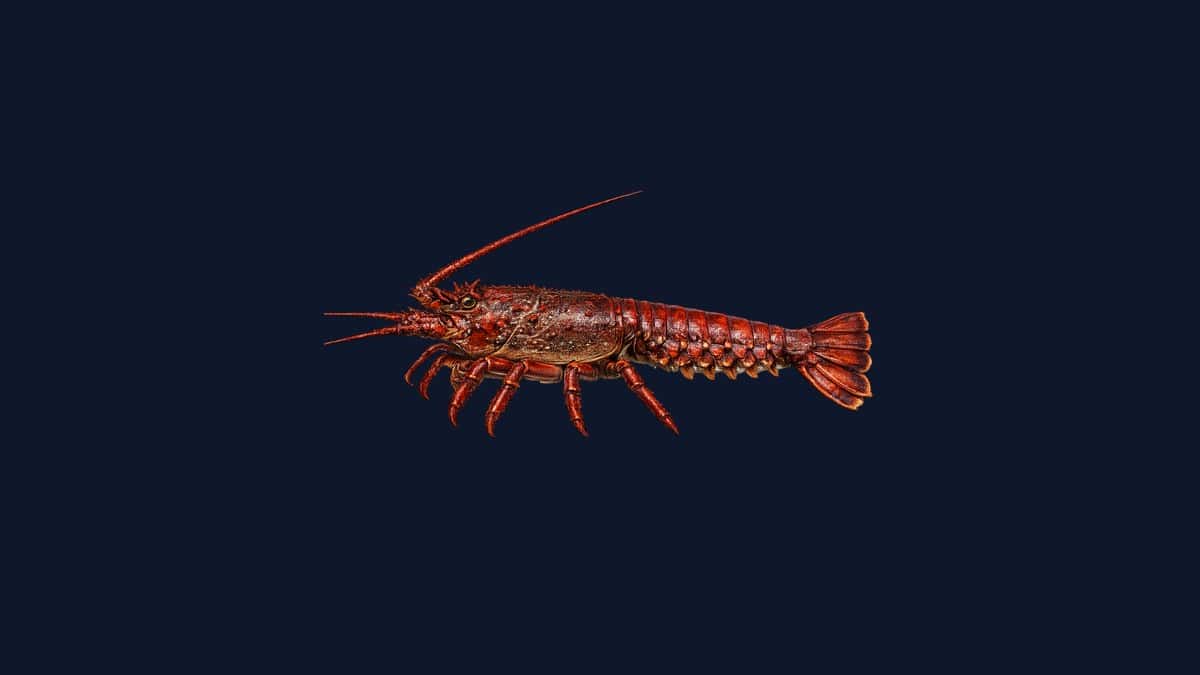
California spiny lobster studio illustration — rust-red carapace with long spiny antennae and no claws, against a black background.
All Species

California Spiny Lobster

Panulirus interruptus

Season: Opens 6:00 p.m. Friday before first Wednesday of October (Sept 26, 2025); closes midnight first Wednesday after March 15 (March 18, 2026)1 lb – 8+ lbs (exceptional; most legal fish 1–3 lbs)

Southern California's premier crustacean. Spiny lobsters have no claws — they're all antenna and tail muscle. They hide in rocky crevices by day and emerge to feed at night. Hoop net or hand capture only; no traps, no spears.

Illustration: Fish City

About Spiny Lobster

California spiny lobsters (Panulirus interruptus) are the SoCal reef's premier nocturnal predator-scavenger. They're claw-less — not related to Atlantic clawed lobsters (Homarus) but to tropical Palinuridae — and instead of claws they have two long, spiny antennae they use as weapons and tactile sensors. A legal-size California lobster runs 1 to 3 pounds; the state record approaches 15 pounds for an exceptional individual. Most fish you'll bag are in the 1–2 lb range.

Range: from roughly Point Conception south into Baja California. Point Conception is a hard thermal boundary — water north of there is too cold for a breeding population. Point Loma, La Jolla, Palos Verdes, Catalina, and the Channel Islands are the money zones. Santa Barbara mainland and the Northern Channel Islands mark the northern range limit.

They're nocturnal. By day, they den up in rocky crevices, kelp holdfasts, and ledges. At night, they emerge to forage on sea urchins, mussels, and carrion. That behavior dictates every tactical choice: bait smelly and soak long (hoop net); dive dark and move slow (hand capture). Opening-week night dives at Catalina regularly produce 7-fish limits. Day dives produce dens — you see the antennae, not the body — and rarely produce legal fish that will hold still for measurement.

How to Catch

Two legal methods. Nothing else. Hoop net and hand capture.

Hoop net. Collapsible or rigid ring with a mesh floor, a bait box in the center, and a rope and marked buoy. Drop in 15–80 ft over rocky or mixed hard bottom, ideally near a kelp edge. Soak 45 to 90 minutes — lobster come to the bait, sit on the net floor, and get lifted when you pull. Max 5 hoop nets per diver; max 10 per vessel (§ 29.80). Bait options: salmon skins (the SoCal favorite), mackerel carcass, any oily fish. The classic pattern is deploy at dusk, pull through the evening, retrieve near midnight.

Hand capture. Freedive or SCUBA into the rocks with a light, a gauge on a lanyard, a tickle stick, and a game bag. Locate lobster in crevices — antennae are the tell. Work the lobster out of the crevice gently with the tickle stick. When it's exposed, gauge it in the water (do NOT remove undersized animals). If legal, grip the carapace firmly (not the antennae; they snap off) and into the bag. Night diving is vastly more productive because lobsters have emerged from dens.

What's not legal. Trapping is commercial only. Spearing is prohibited. You cannot use a SCUBA-assisted device to pry lobster from crevices — the regulation permits SCUBA as a diving method, but the capture must be by hand.

Eating Profile

Excellent. Tail meat only (no claw meat — no claws) — sweet, firm, slightly sweeter than Atlantic clawed lobster in direct comparison. The body carapace yields very little, and most SoCal prep is focused on the tail. A 1.5 lb lobster yields roughly 6 oz of tail meat.

Classic prep: split the tail lengthwise, brush with garlic butter, broil 6–8 minutes. Don't overcook — spiny lobster tail gets rubbery past 140°F internal. Store live in a bucket of seawater until cooking; do NOT use fresh water (they'll die quickly). If not cooking the same day, kill and freeze immediately; the meat degrades fast.

The head / thorax is inedible but makes excellent stock for lobster bisque.

Common Mistakes

  • Using a trap. Commercial only. Opening-week wardens cite this constantly.
  • Pulling undersized lobsters from the water to measure. Must be measured IN water while diving; hoop-net operators measure immediately upon pull. Pulling an under-gauge lobster out of the water is a violation even if you intended to release.
  • No Lobster Report Card in possession. The card is required under § 29.91 — not a suggestion. Entries must be made before fishing starts and when moving locations or finishing. Wardens check cards.
  • Fishing south of Point Arguello without Ocean Enhancement Validation. Required unless on a 1- or 2-day license.
  • Day diving and wondering where the lobsters are. They're in dens. Night diving is ~5x more productive.
  • Bagging a lobster with eggs underneath (berried female). Egg-bearing females must be released in California. Check the abdomen before retention — visible orange egg mass = release.

Month-by-Month

  • Apr–Sep: CLOSED. No recreational lobster take. Plan gear, scout reef, prep hoop nets.
  • Sep (late): Opening Friday at 6 p.m. — for 2026, that's October 2, 2026. Crowds on the water are intense opening night; consider mid-week alternatives to the first two days.
  • Oct: Peak bite. Water still warm enough for comfortable night diving; lobsters active and moving freely after molt.
  • Nov–Dec: Strong action continues. Water cooling but not yet cold; lobsters remain accessible at 30–60 ft. Thanksgiving lobster is a SoCal tradition.
  • Jan–Feb: Colder water; lobsters move deeper and get less aggressive on the net. Hand-dive picks up as visibility improves post-winter storms.
  • Mar: Final push. Season closes at midnight on the first Wednesday after March 15 (March 18, 2026). Last legal take of the regulatory year.


Where to Catch California Spiny Lobster in California

  • Rocky reef edges and kelp forest holdfasts (daytime dens; hunting at night)
  • Point Loma, La Jolla, and the San Diego kelp beds
  • Palos Verdes and the Los Angeles coast
  • Channel Islands — Santa Catalina, San Clemente, Anacapa, San Nicolas, Santa Cruz
  • Santa Barbara mainland and the Northern Channel Islands (northern range limit ~Point Conception)
  • Hoop-net productive depth: 15–80 ft over reef and kelp-adjacent hard bottom

Conditions & Habitat

Water Temp

55–70°F; warm-temperate SoCal species, range Point Conception into Baja

Typical Depth

5–200 ft on rocky reef and kelp; most recreational catch in 15–80 ft

Diet

Sea urchins, mussels, clams, worms, algae — nocturnal scavenger and grazer

How to Catch California Spiny Lobster

Techniques

  • Hoop net baited with salmon skins, fish carcasses, or mackerel — dropped 45–90 min per soak, rebait, reset
  • Hand capture by freedive or SCUBA in rocky crevices — tickle stick plus gloved hand, measure IN water before extraction
  • Night work outproduces day — lobsters emerge from dens after dark to feed
  • Maximum 5 hoop nets per diver and 10 per vessel (§ 29.80)
  • Measure with a lobster gauge (3¼-inch carapace length) before removing from water — divers must measure in-water

Lures & Baits

  • Hoop net (collapsible) with bait box — the standard SoCal rig
  • Bait: salmon skins (the SoCal favorite), mackerel carcass, oily fish scraps
  • Tickle stick (3–4 ft rod) — for coaxing lobster out of crevice during hand capture
  • Game bag / catch bag — for holding measured, legal lobsters during dive

Line & Leader

Hoop nets: 150–250 ft of 3/8-inch polypropylene to a marked surface buoy (buoy must display diver/angler name and GO ID per § 29.80). No rod-and-reel — this is net and rope work, or diving.

Rod & Reel Combos

  • No rod needed — hoop nets run on hand-pulled line or a rail-mounted puller
  • Dive setup: standard SoCal kelp dive kit (mask, fins, weight, lights for night), lobster gauge on a lanyard
  • Bait-box attachment: perforated hard-plastic box or mesh bait bag — secure so bait doesn't wash out on the drop

Regulations

Recreational daily bag: **7 lobsters per person** (14 CCR § 29.90). Minimum size: **3¼ inches carapace length**, measured in a straight line on the midline of the back from the rear edge of the eye socket to the rear edge of the body shell. Divers must measure lobsters **in the water** before removing them; hoop-net operators must measure immediately upon removal. Lobsters must be kept whole and measurable until prepared for immediate consumption. Season: opens at 6:00 p.m. on the Friday preceding the first Wednesday in October (**September 26, 2025** for the 2025-26 season), closes at 11:59:59 p.m. on the first Wednesday after March 15 (**March 18, 2026**). Required documents: **California sport fishing license + Spiny Lobster Report Card** (14 CCR § 29.91; report-card entries must be made before starting and upon finishing at each location). **Ocean Enhancement Validation** is also required if fishing south of Point Arguello (Santa Barbara County), unless using a 1- or 2-day sport fishing license. Legal methods: hoop net (max 5 per diver / 10 per vessel) and hand capture only. **No traps. No spears. No SCUBA-assisted extraction beyond the hand-capture method** (you may dive with SCUBA, but you must capture with your hands). As of April 20, 2026, the season is **closed** — it reopens Friday, October 2, 2026.

As of April 20, 2026 — CDFW source

Did You Know?

Spiny lobsters have no claws — their defense is a powerful tail flick (the 'tail kick' that lets them shoot backward) and a pair of sharp, forward-pointing antennae they use to jab at predators. They also travel single-file in seasonal migrations, forming 'lobster trains' of 30–50 animals queued nose-to-tail across open sand — a behavior thought to offer predator protection and efficient movement between reef systems.

Book a California Spiny Lobster Charter

Find charter boats targeting California Spiny Lobster at these California landings:

Frequently Asked Questions

The regulation reads 'the Friday preceding the first Wednesday in October.' For 2026, the first Wednesday in October is October 7, so the preceding Friday — opening day — is **October 2, 2026 at 6:00 p.m.** The 2025-26 season closed at midnight on March 18, 2026, and the fishery is closed now (April 20, 2026).

Sources

Ready to Find the Bite?

Join thousands of California anglers using Fish City for real-time fish counts, reports, and charter data.

Download on the App StoreGet it on Google Play

Free — no subscription required