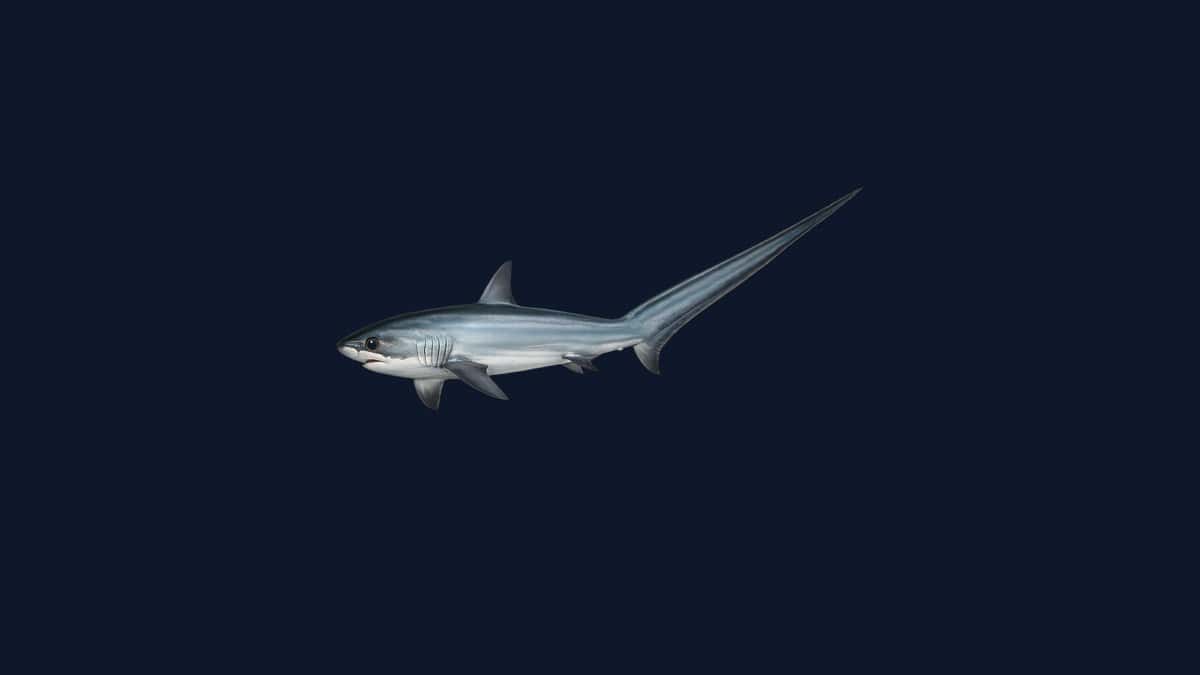
Common thresher shark studio illustration — shark with elongated upper tail lobe as long as the body, blue-gray back, white belly, against a black background.
All Species

Common Thresher Shark

Alopias vulpinus

Season: June through October (peak July–September)50 lbs – 250+ lbs

The most commonly targeted offshore shark in SoCal. The thresher's elongated tail fin — often as long as the body — is the giveaway at color. They're warm-blooded, jump, and the meat is excellent.

Illustration: Fish City

About Common Thresher Shark

Common thresher sharks are the most frequently caught large shark off California. They're easier to find than mako, appear earlier in the summer season, and are more forgiving on lighter tackle. A 150 lb thresher at color is an impressive fish — and immediately identifiable by the upper tail lobe, which is typically as long as the rest of the body.

FishBase records a maximum length of 573 cm (18.8 ft) and max weight of 348 kg (767 lb). Most fish encountered in Southern California run 60–175 lb, with 200+ lb specimens encountered regularly on overnight trips to the deep banks. The California state record is 575 lb (Daniel D. Lara, Carlsbad Canyon, 2007).

Common threshers are classified as Vulnerable by IUCN (2018 assessment), with declining populations in some regions due to commercial fishing pressure. The California recreational fishery is managed under 14 CCR § 28.42 (2-fish bag limit). The CITES Appendix II listing restricts international commercial trade.

How to Catch

Threshers are more accessible than mako on standard party-boat shark trips. The formula:

Live sardine fly-lined is the first choice — a 6–8 inch sardine on a 7/0–9/0 circle hook, 100–150 lb mono leader, no weight, let it swim naturally behind the chum slick. Threshers key on sardine and anchovy schools; presenting a healthy sardine in the slick is straightforward.

Chum is essential. Ground sardine or mackerel ladled off the stern creates a scent column that brings fish up from depth. Maintain a steady drip, don't dump all at once.

Multiple depths work on threshers: one bait shallow (20–40 ft), one mid (60–80 ft), one deep (100+ ft). Threshers cruise the water column vertically while hunting.

The bite is usually aggressive — the rod doubles over and the fish takes line. They fight hard on the initial run and often jump. A 150 lb thresher will make a run of 100–200 yards before turning. Circle hooks eliminate most gut-hook losses.

Eating Profile

Thresher is excellent eating. Firm, mild, dense white-to-pink flesh — often compared to swordfish or mako in texture. The belly is particularly good smoked. Standard shark handling protocol applies: bleed the fish immediately on deck, put it on ice, fillet within 12 hours. Remove the darker lateral line meat along the backbone; it concentrates urea and has a stronger flavor.

IUCN lists the species as Vulnerable. Keep what you'll actually eat and release the rest — these fish are slow-growing and recover slowly from fishing pressure.

Common Mistakes

  • Waiting too long to set the hook. With circle hooks on threshers, don't wait — when the rod loads, reel down hard and let the circle do its job. Waiting gives the fish time to feel resistance and drop the bait.
  • Too-light leaders. Threshers are not as aggressive about cutting leaders as mako, but they roll. 100 lb mono minimum.
  • Fishing when there's no chum. Without a scent trail you're just drifting. Maintain the chum drip — that's what brings fish to your baits.
  • Misidentifying at color. The tail is obvious. But if a fish comes up and you're not sure it's a thresher, slow down and look before you do anything.

Month-by-Month

  • Jan–May: Absent in SoCal. Fish are deeper and offshore.
  • Jun: First fish of the season appear on nearshore banks. Smaller average.
  • Jul–Sep: Peak. Best numbers, good average size, most predictable on established shark-trip grounds.
  • Oct: Productive through mid-month. Fish begin moving as water cools.
  • Nov–Dec: Rare; season effectively over.

Where to Catch Common Thresher Shark in California

  • Offshore banks (400–1,000 ft) off San Diego
  • Tanner Bank
  • San Diego offshore ridges
  • Around offshore kelp paddies in summer
  • Continental shelf edges where bait schools concentrate

Conditions & Habitat

Water Temp

60–72°F; warm-blooded, common in SoCal from June through October

Typical Depth

Surface to 500 ft; hunt bait schools at mid-depth, come to the surface on chum

Diet

Sardines, anchovies, mackerel — stuns schooling fish with the elongated upper tail lobe

How to Catch Common Thresher Shark

Techniques

  • Live sardine on 7/0–9/0 circle hook, fly-lined on 100–150 lb leader
  • Live mackerel drifted deeper on a rubber-core sinker
  • Chum slick with ground sardine to bring fish to the surface
  • Live bonito presentations for larger fish
  • Dead sardine or mackerel slow-drifted on a flat line

Lures & Baits

  • Live Pacific sardine (6–8 in) — the primary thresher bait
  • Live Pacific mackerel (8–12 in) for larger fish
  • Dead rigged sardine on circle hook, fly-lined with no weight
  • Ground sardine chum ladle-fed to maintain scent trail

Line & Leader

50–80 lb braid mainline, 100–150 lb monofilament leader (4–6 ft). Threshers are not as leader-sensitive as mako. Circle hooks 7/0–9/0 — standard for minimizing gut hooks.

Rod & Reel Combos

  • Penn Fathom 40N 2-speed on a 7 ft 40–80 lb stand-up rod — workable for fish to 200 lb
  • Shimano Talica 20 or Penn International 30 on a 6 ft 30 lb class rod for lighter setups

Regulations

Daily bag limit: 2 common thresher sharks per angler (14 CCR § 28.42). No California minimum size. Season open year-round. Always verify current CDFW regulations before targeting threshers — limits are set by Fish and Game Commission and can change.

As of April 20, 2026 — CDFW source

Did You Know?

Common thresher sharks are warm-blooded, like mako and tuna. They use a rete mirabile countercurrent heat exchanger in their tail musculature, keeping the massive caudal fin musculature warmer than the ambient water. That elevated tail-muscle temperature is part of what makes the tail-whip strike fast enough to stun multiple fish in a single stroke.

Boats Known for Common Thresher Shark

Charter boats with a track record on this species.

El Gato

H&M Landing

overnight shark and mixed offshore trips

Tribute

Fisherman's Landing

1.5-day offshore runs targeting shark and tuna

Book a Common Thresher Shark Charter

Find charter boats targeting Common Thresher Shark at these California landings:

Frequently Asked Questions

The elongated upper lobe of the tail (heterocercal caudal fin) is used as a hunting weapon. Threshers herd schools of sardines or anchovies into tight balls, then whip the tail through the school to stun or kill multiple fish at once. You can sometimes see this behavior at the surface as a tail slap above the water line, with stunned baitfish scattered around. It's one of the more unusual predation strategies in the shark world.

Sources

Ready to Find the Bite?

Join thousands of California anglers using Fish City for real-time fish counts, reports, and charter data.

Download on the App StoreGet it on Google Play

Free — no subscription required