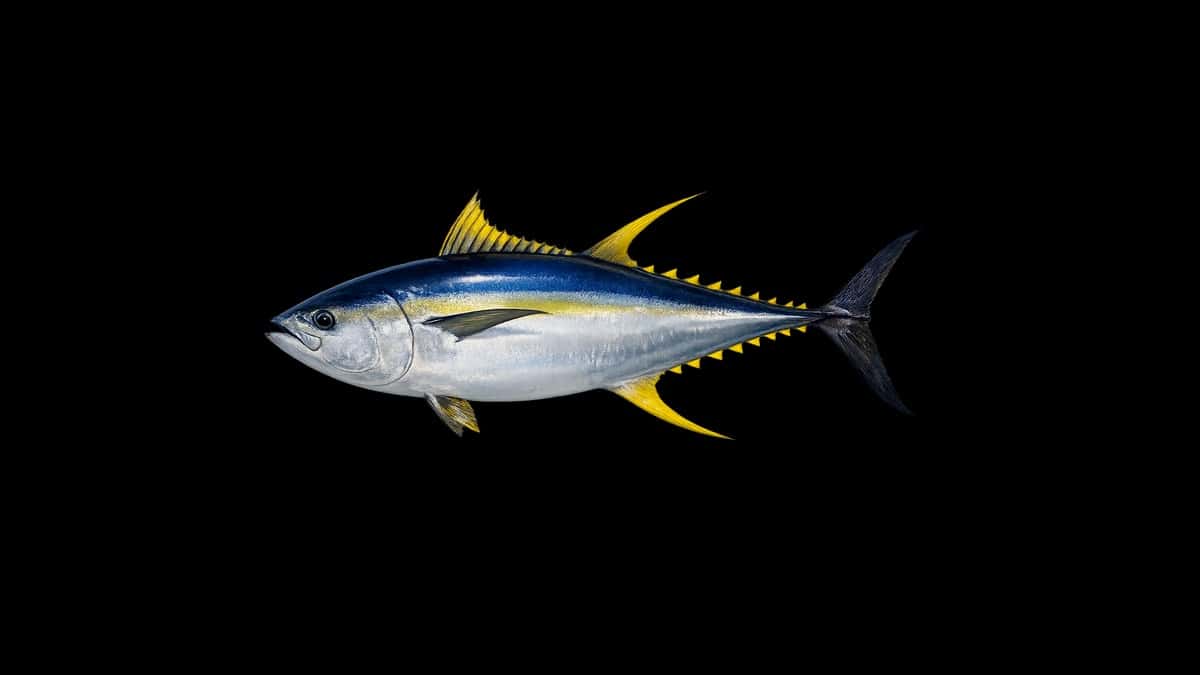
About Yellowfin Tuna
Yellowfin are the approachable ahi. Not the 300-pound monsters of the Pacific equator — those swim offshore of Hawaii and off Baja, and California gets the edge of that population. SoCal yellowfin run 15 to 80 pounds on 1.5-day and overnight trips, and the long-range boats (7+ days) pick up the 100-pounders down the coast near Cedros Island.
They're warm-water fish. The season kicks on when the water hits 68°F+ — typically July in a good year, late August in a cold one. A cool SoCal summer (like 2022) might produce almost no local yellowfin. A strong El Niño year (2015) produces 50-fish days on 1.5-day trips inside 50 miles.
How to Catch
The modern SoCal yellowfin game is metal jigs on the meter. Fly-lining a sardine at a paddy still works — that's classic yellowtail fishing — but yellowfin tuna have adapted to warm-water depth schools and the best boats fish them with electronics first, bait second.
Flat-fall and knife jigs are the primary program. The boat runs the deep-water electronics hard, marks a school at 150 to 300 ft, and the deckhands call out the depth. Drop a 200-gram Shimano Butterfly Flat-Fall (glow or blue sardine) or a Daiwa SK knife jig in silver or sardine, let it fall on a taut line, and work it back up. Butterflies bite on the fall — a slow weight, then the rod loads. SK jigs like a faster rhythm — short, sharp lifts as you reel up through the school. Don't rip; don't stop. When a tuna grabs, just reel.
Live bait on kelp paddies is a yellowtail-first program that often catches yellowfin when they're mixed in. When the boat pulls up on a paddy and the deckhands start chumming, grab a lively sardine or anchovy, nose-hook it on a 1/0 to 2/0 circle, and fly-line it — no weight — at the kelp edge. If yellowfin are under the paddy, they'll eat. The circle hook sets itself — lean into the rod, don't swing.
Trolling catches your first fish of the day. Boats run cedar plugs and feathers at 6 to 8 knots between paddies and meter marks; when you hook up, the rest of the school often swims with the hooked fish and a blitz follows — either a bait blitz (live sardines) or a jig blitz (drop flat-falls while the boat stops).
Eating Profile
Sashimi-grade if handled right. Yellowfin flesh is pink-red, medium firm, milder than bluefin. A 30-lb fish gives you maybe 8 to 10 lbs of clean loin. Sear it with sesame oil and soy; slice it raw for poke; or grill pieces to medium-rare and eat with rice and ponzu.
The bleed is everything. Cut the gill rakers deep on both sides immediately after landing. Submerge the fish in slush (ice + seawater) for the rest of the trip. A yellowfin that warms up or sits on deck in the sun turns dark and mushy fast. Landings charge extra to fillet on dock — use them; it's worth $40 for a perfect loin.
Seafood Watch rates California hook-and-line yellowfin as Good Alternative — the US/Mexico Pacific stock is healthy and the hook-and-line method has low bycatch.
Common Mistakes
- Ripping a flat-fall. The strike is on the fall or on a slow lift — not on a ripping jerk. Work the Butterfly like it's a sinking sardine, not a fight. SK jigs take a faster cadence, but still rhythmic — not frantic.
- Missing the fall bite. Most flat-fall strikes happen on the drop. If you feed slack line on the way down, you'll never feel the tap. Keep light thumb pressure, watch the line, and be ready to reel the instant anything feels different.
- Fishing the wrong jig weight for depth/current. A 150g in strong current at 250 ft is swinging horizontally behind the boat. Captains call the right weight for conditions — 200 or 250g is common in the SoCal tuna program. Match it.
- Fly-lining with too heavy line at a paddy. When yellowfin do come up on a paddy, they see your leader. A 100 lb leader with a 3/0 hook is too much — drop to 50 or 60 lb fluoro and a 1/0 circle; your bite rate doubles.
- Not bleeding the fish. Every yellowfin you don't bleed loses 30% of its sashimi value. Every one you bleed becomes grocery-store-beating tuna.
- Skipping the long-range option. A 3-day trip out of San Diego runs $900 to $1,500 and produces 3x to 5x the fish of a 1.5-day. If the warm-water pocket is 100 miles south, the overnight fleet can't reach it. The long-range can.
Month-by-Month
- Jan–Jun: No yellowfin. Water's too cold. Go after bluefin or wait.
- Jul: First arrivals in warm years. 1.5-day trips begin finding scattered paddies with 10–30 lb fish. Long-range trips already producing south.
- Aug: Building. Paddies in 72°F+ water consistently hold schools. Mixed with dorado.
- Sep–Oct: Peak. Best window in warm years. 50-fish days on overnight trips, 20+ lb averages, 60+ lb bulls mixed in. Mixed schools with bluefin and dorado.
- Nov: Bite winding down but still live. Warm-water pocket shifts south; long-range boats stay on them.
- Dec: Gone from SoCal water. Long-range trips to Cedros still produce down into Mexico.