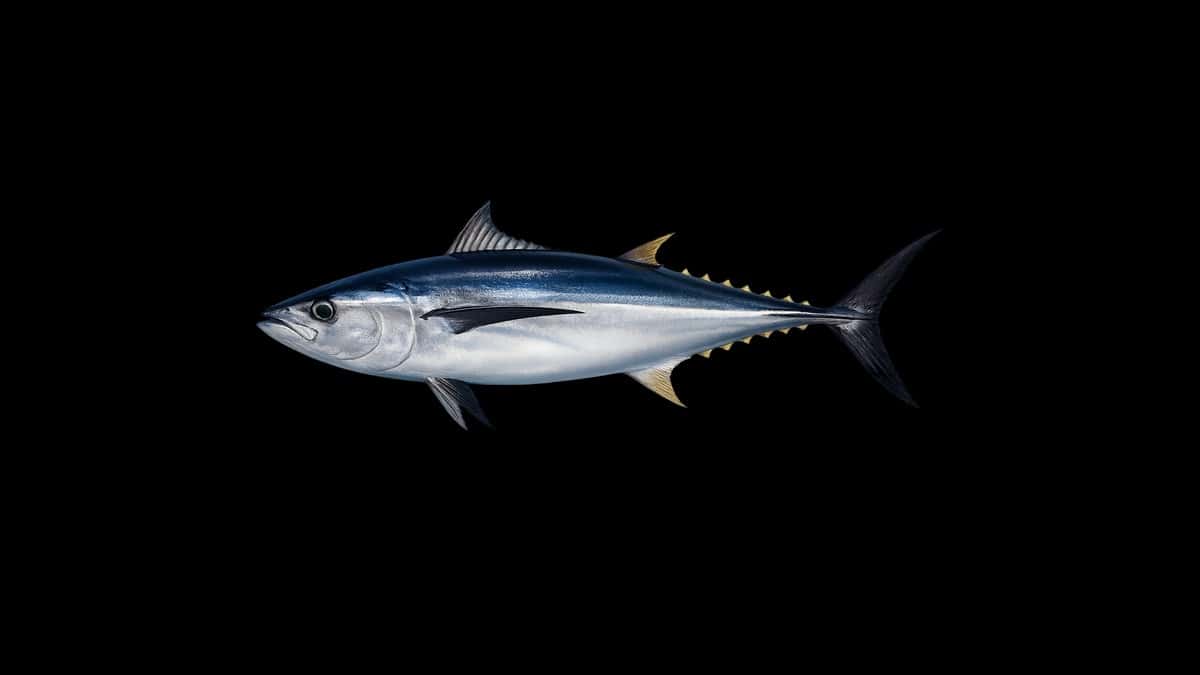
Albacore tuna studio illustration — long-finned tuna with distinctive elongated pectoral fins and dark blue back — against a black background.
All Species

Albacore Tuna

Thunnus alalunga

Updated · Published

Season: July through November (peak Aug–Sep in SoCal, Sep–Oct in Central/NorCal)10 lbs – 40+ lbs

The long-run summer visitor. Albacore migrate thousands of miles to reach California water each summer, pull hard on 30-lb gear, and fillet into the best canned tuna on the planet.

Illustration: Fish City

Albacore Season California

California albacore run July through November, peaking August–September in SoCal and September–October on the Central and North Coast. They're migrators — July brings first arrivals 60–100 miles offshore, and the fishery has been weak inside 40 miles in recent seasons.

Albacore Bag Limit California

California sets a 10-fish albacore bag south of Point Conception and 25 fish north, per 24-hour period under 14 CCR § 28.38 — separate from the 20-finfish general aggregate. No minimum size. Multi-day permits allow up to three daily limits.

Best Months for Albacore

August–September is the SoCal peak; September–October shifts the bite to Central Coast and NorCal ports (Morro Bay, Monterey, Half Moon Bay, Bodega). Water temperature breaks at 60–64°F are the key — look for where green 58°F water meets cobalt-blue 62°F+ water.

How to Catch Albacore

Troll cedar plugs and feathers at 6–8 knots across the thermocline edge until a rod doubles. On hook-up, throttle down, chum live anchovies, and fly-line bait in the slick — you'll often load the boat at one stop. Drop chrome knife jigs 100–200 ft when fish mark deep.

Where to Catch Albacore in California

Offshore water 40–100+ miles from the coast, on temperature breaks at the edge of warm current. San Diego banks (302, Butterfly, 425) produce early-season fish; Morro Bay, Monterey, Half Moon Bay, Bodega, and Eureka fish traditional Central/NorCal grounds.

About Albacore

Albacore are the migrators. They aren't full-time California residents like yellowtail or sand bass — they're highly migratory pelagic tuna that swing through SoCal and Central California water each summer on their trans-Pacific commute. Good year = they're inside 40 miles and you can catch 20 in a day. Bad year = they're 100+ miles offshore and only the long-range boats reach them.

Recent SoCal reality check: Albacore have been weak to virtually absent off San Diego and Long Beach in the last several seasons — the warm-water blob pushed the fishery north and west, and the SoCal day fleet has mostly fished yellowfin and bluefin instead. Central and Northern California (Morro Bay, Half Moon Bay, Bodega Bay) have continued to see periodic albacore pushes. Book on current radio and spotter-plane reports, not historical averages.

Typical albacore in California water run 10 to 25 pounds. A 30–40-pounder is a quality fish; anything 60+ is record-class, usually only seen on long-range trips. NOAA lists max size at "almost 80 pounds and about 47 inches long," while the FishBase max is 140 cm fork length and 60.3 kg (~133 lbs). The IGFA all-tackle world record is 88 lb 2 oz, caught off Gran Canaria, Spain in 1977 — the species ceiling, not what you'll see off California. Their distinguishing feature is the extra-long pectoral fin — per NOAA it is "at least half the length of their bodies" and extends "well beyond the front of the anal fin, usually as far as the second dorsal finlet." (Juvenile bigeye can look similar; albacore pectorals taper to a point while juvenile bigeye are more rounded.) Flesh is the lightest of any tuna, which is why only albacore can be labeled "white tuna" under FDA 21 CFR 161.190 (Munsell value 6.3 minimum; "light tuna" is 5.3 or lighter, "dark tuna" is darker than 5.3).

How to Catch

Trolling finds them, bait holds them. The pattern hasn't changed in 50 years.

You run offshore to the temperature break (your captain watches SST maps and spotter reports), pull out a 6-rod trolling spread with cedar plugs and feathers, and cover water at 6 to 8 knots. Cedar plugs — plain wooden bullets painted on the nose — are legendary on albacore. Nobody knows exactly why they work; they just do. Color doesn't matter much.

When a rod doubles over, the deckhand yells "hook-up" and the entire pattern changes. Throttle drops. Chummers start tossing live anchovies in the wake. Everyone drops a live-bait rod to the rail and fly-lines a live anchovy or sardine with no weight. The hooked fish drags a school of followers up into the chum slick, and you can pick up 5 to 10 more fish per stop.

Go lighter on the leader than you think. Albacore are line-shy in blue water. Start with 40–50 lb fluorocarbon on chum-stop bait rigs and drop to 30 lb when they're picky. Keep the trolling gear heavy (they hit trolled lures through any line), but thin out the bait rig.

Knife-jig when they're deep. Some days they mark on the meter at 100 to 200 ft but won't come up. Drop a chrome knife jig and work it with fast rips; fish eat on the upstroke. This is newer and works when the surface bite dies.

Eating Profile

The best canned tuna, period. Fresh albacore steaks are light pink, mild, and slightly softer than yellowfin. Sear to medium-rare with sesame and soy, or pressure-can your own jars with olive oil for the best pantry tuna of your life. A 20-lb albacore produces 8–10 lbs of clean loin — two pressure-canner batches of 12 half-pints.

Bleed immediately. Cut both gill rakers deep on deck. Ice hard in slush. Fillet within 24 hours. Albacore flesh browns faster than yellowfin if it warms — don't sleep on the bleed-and-chill.

Seafood Watch rates albacore caught by troll or pole-and-line in U.S. and British Columbia waters as a Best Choice — the stock is well-managed and the fishery has low bycatch. Longline and purse-seine catch methods get rated yellow to red (Good Alternative to Avoid) due to sea turtle, shark, and seabird bycatch — so look for troll or pole-and-line on the label when you buy at the market.

Common Mistakes

  • Sleeping on the bleed. A dead-on-deck albacore that warms for 20 minutes loses half its flavor. Cut the gills the moment it's off the deck and get it in slush.
  • Trolling too fast. 10 knots is trolling for marlin, not albacore. Keep it 6 to 8 — slow enough that cedar plugs dance, not skip.
  • Heavy fluoro on chum bait. Drop to 30–40 lb fluorocarbon for fly-lined bait; your bite count doubles. Albacore see line in the clear blue water.
  • Giving up on the first fish. The first hook-up is rarely the last. When a rod doubles, stay there — chum hard and get live bait in the water. You'll often load the boat at one stop.
  • Skipping pressure canning. 10 lbs of frozen albacore is OK eating for 6 months. 10 lbs of home-canned albacore is pantry gold for two years.

Month-by-Month

  • Jan–Jun: No albacore in California water. They're in the Western Pacific.
  • Jul: First arrivals offshore of San Diego. 1.5-day trips start scoring on scattered fish 60–100 miles out.
  • Aug: Peak building. SoCal bite solidifies; fish push inside 60 miles. Central Coast still a few weeks out.
  • Sep: SoCal peak and Central Coast bite turns on. Morro Bay and Monterey boats start running. Best boat-filling window of the season.
  • Oct: Central/NorCal peak. Bite shifts north as warm water pushes up. Half Moon Bay, Bodega, and Eureka produce. SoCal bite slows.
  • Nov: Tail end. Fish move offshore and south as water cools. Long-range boats pick up the last schools.
  • Dec: Gone. See you next July.

Where to Catch Albacore Tuna in California

  • Offshore water 40–100+ miles from the coast
  • Temperature breaks at the edge of warm current
  • San Diego offshore banks (302, Butterfly, 425)
  • Central Coast (Morro Bay, Monterey) — traditional albacore grounds
  • Pacific Northwest offshore (when the warm water pushes up)

Conditions & Habitat

Water Temp

58–66°F; sweet spot is 60–64°F; look for breaks where green 58°F water meets cobalt-blue 62°F+ water

Typical Depth

Surface to 200 ft when feeding (fishing-relevant column); biological range surface to 600 m (~2,000 ft) per FishBase. Will come up from 100+ ft for trolled lures.

Diet

Pacific saury, northern anchovy, gonatid squid, Japanese anchovy, and crustacean zooplankton per FishBase; sardines, mackerel, and pelagic red crabs also in rotation in warm-water years

How to Catch Albacore Tuna

Techniques

  • Troll cedar plugs and feathers at 6–8 knots — hands-down the #1 technique
  • Chum live anchovies or sardines after hooking up on the troll to hold the school
  • Fly-line live bait in the chum slick once fish are behind the boat
  • Jig knife jigs (chrome, blue) at 100–200 ft if fish mark deep
  • Cast surface iron at boiling fish when they chase bait to the surface

Lures & Baits

  • Cedar plugs (natural, painted head) trolled 60–150 ft behind boat — the legend
  • Tuna feathers (purple/black, green/yellow, zucchini) in a 6-rod spread
  • Rapala CD-14 or X-Rap Magnum 15 (mackerel, blue/silver)
  • Knife jigs (chrome, blue/silver) 150–200g for deep meter marks
  • Live anchovy or sardine fly-lined in chum slick

Line & Leader

30–50 lb braid or mono mainline, 40–50 lb fluorocarbon leader (4–6 ft). Drop to 30 lb fluoro on picky chum-stop fish. Keep trolling gear heavier since albacore hit trolled lures through any line class.

Rod & Reel Combos

Product links may earn Fish City a small commission at no extra cost to you. We only recommend gear we'd use ourselves.

Regulations

Albacore are on a SEPARATE sub-limit under CCR Tit. 14 § 28.38 — 10 fish south of Point Conception (34°27' N. latitude) or 25 fish north of Point Conception, on the basis of each 24-hour period at sea — taken IN ADDITION TO the general 20-finfish daily aggregate (§ 27.60). No minimum size. Multi-day trips require a Declaration for Multi-Day Fishing Trip permit filed with CDFW (48 hours before departure), which allows possession of up to three daily bag and possession limits (NOT unlimited per-day accumulation); the 12-hour rule caps the first and last day at a single daily limit each. Pacific bluefin has its own stricter multi-day cap (4 fish for 2-day, 6 fish for 3+ days). Federal HMS rules (50 CFR § 660.721) explicitly defer to more restrictive state rules — California's regulations are the operative cap for sport anglers. Always verify current CDFW regulations before your trip.

As of April 19, 2026 — CDFW source

Did You Know?

Some North Pacific albacore make trans-Pacific migrations of 5,000+ miles round trip — from waters off Japan to the California coast and back — typically as juveniles 2 to 4 years old. But tagging studies (Childers et al. 2022) show the species is variable: some individuals cross an ocean in a season while others stay resident in the California Current year-round. Either pattern, it's one of the longest migrations of any tuna.

Boats Known for Albacore Tuna

Charter boats with a track record on this species.

Pacific Queen

Fisherman's Landing

overnight + 1.5-day albacore and mixed tuna

American Angler

Point Loma Sportfishing

long-range offshore albacore runs

Fiesta

Virg's Landing (Morro Bay)

Central Coast tuna and mixed offshore

Queen of Hearts

Pillar Point Harbor (Half Moon Bay)

NorCal albacore when in range, plus rockfish and salmon

Book a Albacore Tuna Charter

Find charter boats targeting Albacore Tuna at these California landings:

Frequently Asked Questions

Albacore are migratory loners. Unlike yellowfin that group at paddies, albacore spread out and cover huge areas following bait. The only reliable way to find them is to troll lures at 6–8 knots across the thermocline edge and hope one eats. Boats often run 40–100 miles offshore, troll for 4+ hours, and hook up on the first fish. When they do, the whole boat goes to live bait and chunking to hold the school.

Sources

Ready to Find the Bite?

Join thousands of California anglers using Fish City for real-time fish counts, reports, and charter data.

Download on the App StoreGet it on Google Play

Free — no subscription required