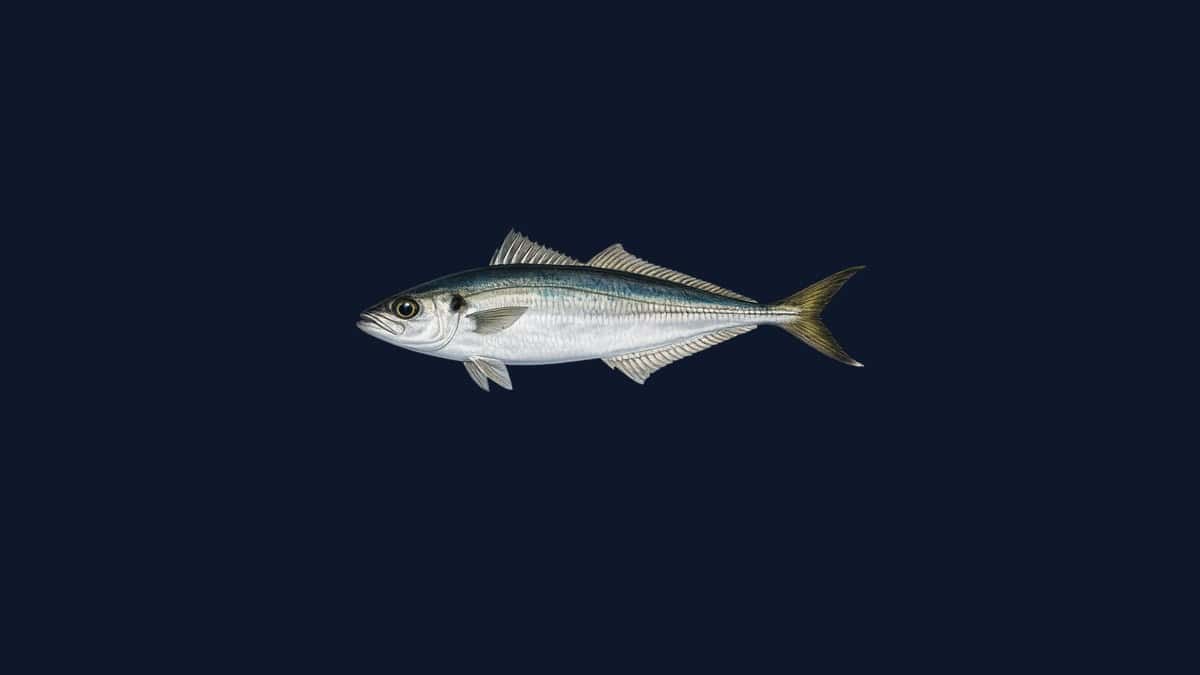
Jack mackerel studio illustration — streamlined carangid fish with a pronounced lateral line scute row and silvery flanks against a dark background.
All Species

Jack Mackerel

Trachurus symmetricus

In Season Now8 oz – 4 lbs

Jack mackerel (*Trachurus symmetricus*) are a true jack — Carangidae, like yellowtail — and they fight like it for their size. A critical forage species, a reliable live bait, and an underrated smoked fish.

Illustration: Fish City

About Jack Mackerel

Jack mackerel (Trachurus symmetricus) occupy a position in the California Current ecosystem that's more important than their reputation among anglers suggests. They're not a trophy, they're not a destination — but they're the fuel that keeps the larger pelagic fishery running. Bluefin tuna, white seabass, yellowtail, and albacore all key on jack mackerel as primary forage. When you're tracking working birds offshore, there's a jack mackerel school driving them.

Despite the common name, they're not in the same family as Pacific mackerel. Trachurus symmetricus belongs to Carangidae — the jack family — making it a relative of yellowtail, amberjack, and pompano, not of tuna. The scute plates along the lateral line are the tell: bony projections along the rear half of the body that no true scombrid has.

FishBase documents the maximum size at 81 cm (about 32 inches), which is larger than most California anglers think. Common length is 55 cm — about 22 inches. The everyday catch runs smaller, 10–16 inches, but the species can grow into genuinely good live-bait size.

How to Catch

Sabiki rigs and small iron. Jack mackerel aggregate offshore in mid-water schools — often visible on sonar as dense returns at 50–200 feet. Drop a Sabiki rig (size 6–8) through the mark and retrieve steadily; you'll often come up with two or three fish at once.

When fish are boiling at the surface near kelp paddies or structure, small iron jigs and Kastmaster spoons retrieved fast produce hook-ups on nearly every cast. The retrieve speed matters: slow gets ignored, fast triggers reaction strikes.

The most productive use of jack mackerel, practically speaking, is loading a livewell at the start of a long-range day and using the larger individuals as live bait for tuna and yellowtail. A 12–14 inch live jack mackerel free-lined in the prop wash or on a 6/0 circle near structure is one of the better big-fish presentations available.

Eating Profile

Underrated, underutilized, requires proper handling. Jack mackerel flesh is dark, oily, and rich — the Japanese have eaten it as 'aji' (horse mackerel) for centuries. In Japan, mackerel sushi and tataki preparations are commonplace.

In California, most jack mackerel get used as bait or thrown back. The ones that get kept often end up tasting fishy and mushy because they aren't bled. Bleed immediately, ice thoroughly, fillet same day. Smoked or pan-seared, the result is genuinely good fish. The oil content handles heat well and prevents the drying problem that ruins rockfish when overcooked.

Common Mistakes

  • Not using a Sabiki rig when you want to load the livewell. Single hook fishing for jack mackerel is inefficient. A Sabiki through a school is 2–3 fish per drop.
  • Fishing light-action tackle for live-bait setup. When the goal is catching 12-inch jacks to use as live bait for 50-lb yellowtail, don't use 8 lb line. You need to get the bait in the well without exhausting it.
  • Skipping the bleed. Same warning as Pacific mackerel — scombrid-adjacent oily fish spoil fast without immediate bleeding and icing.
  • Ignoring depth. Jack mackerel school at various depths. When they're not visible on the surface, look for them on the sonar at 50–150 ft. Drop your rig to the mark.

Month-by-Month

  • Jan–Mar: Mostly offshore in deeper water. Schools less accessible to nearshore anglers.
  • Apr–May: First consistent nearshore appearance. Offshore kelp-paddie fishing starts.
  • Jun–Jul: Peak abundance. Schools present from surface to mid-water throughout the coast.
  • Aug–Sep: Best months for live-bait collection and light-tackle fun. Large schools inshore.
  • Oct: Action continues, schools beginning to move offshore as water cools.
  • Nov–Dec: Mostly offshore; available to long-range boats but not typical nearshore catch.

Where to Catch Jack Mackerel in California

  • Offshore kelp paddies — jack mackerel aggregate around floating structure
  • Temperature breaks and current lines in the Santa Barbara Channel and Santa Monica Bay
  • Nearshore to 30 miles offshore along the entire California coast
  • Around rocky points and island structure
  • Schools show on sonar as dense mid-water returns at 50–200 ft

Conditions & Habitat

Water Temp

58–68°F; cool-temperate schooling species across the California Current

Typical Depth

Surface to 400 ft; found both nearshore and offshore around kelp paddies and current edges

Diet

Small crustaceans, squid, larval fish, krill — pelagic schooling filter feeder and mid-water predator

How to Catch Jack Mackerel

Techniques

  • Sabiki rigs (size 6–8) dropped through a school — fastest way to load a livewell
  • Small metal jigs (1/4–1/2 oz) cast and retrieved fast through surface boils
  • Trolling small plugs or feathers at 4–5 knots along current edges to locate schools
  • Light jigging at depth (50–150 ft) when fish are holding deep — a drop jig with a short fast-jig cadence
  • Live-lining a jack mackerel (10–14 inch) on a 6/0–8/0 circle as bait for yellowtail, tuna, or white seabass

Lures & Baits

  • Sabiki rig size 6–8 — the standard bait-collection rig; drop through the mark and retrieve
  • Kastmaster 1/2 oz (chrome, blue/white) — catches jack mackerel on fast retrieves
  • Small iron jig (1/2–1 oz, sardine, chrome) — effective on both jack and Pacific mackerel
  • Tuna feathers (pink/white, green/yellow) trolled at 4–5 knots

Line & Leader

8–15 lb braid or mono, 10–15 lb fluorocarbon leader. Light line is appropriate — these are 1–3 lb fish on average. The fight on 10 lb gear is legitimate. When targeting as live bait, the Sabiki rig handles its own line management.

Rod & Reel Combos

  • 7 ft light spinning with Shimano Stradic 2500 or Penn Spinfisher 3500, 10 lb braid — fun light-tackle jack setup
  • Any light conventional (Penn Fathom 15, Shimano Calcutta 200) with 15 lb mono for Sabiki efficiency

Regulations

Jack mackerel have NO BAG LIMIT under California ocean sport fishing regulations (14 CCR § 27.60(b) — explicitly listed as a no-limit species). No minimum size. No closed season. Same as Pacific mackerel — the regulations recognize both as abundant schooling forage species. Always confirm current CDFW regulations before each trip.

As of April 20, 2026 — CDFW source

Did You Know?

Jack mackerel are a key prey species for bluefin tuna, white seabass, sea lions, and seabirds throughout the California Current — making them one of the most ecologically important fish in the system. Commercial aerial surveys can track massive jack mackerel schools by following the seabirds and marine mammals that follow the fish. If you're seeing working birds offshore, there's a high probability of a jack mackerel school beneath them — and predators below that.

Book a Jack Mackerel Charter

Find charter boats targeting Jack Mackerel at these California landings:

Frequently Asked Questions

They're actually different families. Jack mackerel (Trachurus symmetricus) is a true jack — family Carangidae, like yellowtail, amberjack, and pompano. Pacific mackerel (Scomber japonicus) is family Scombridae, like tuna. The name 'mackerel' is applied to both because of superficial similarity in size and body shape, but they're not closely related. Jack mackerel have a more pronounced lateral line with scute plates (bony projections) along the rear half of the body, which is a useful field ID.

Sources

Ready to Find the Bite?

Join thousands of California anglers using Fish City for real-time fish counts, reports, and charter data.

Download on the App StoreGet it on Google Play

Free — no subscription required