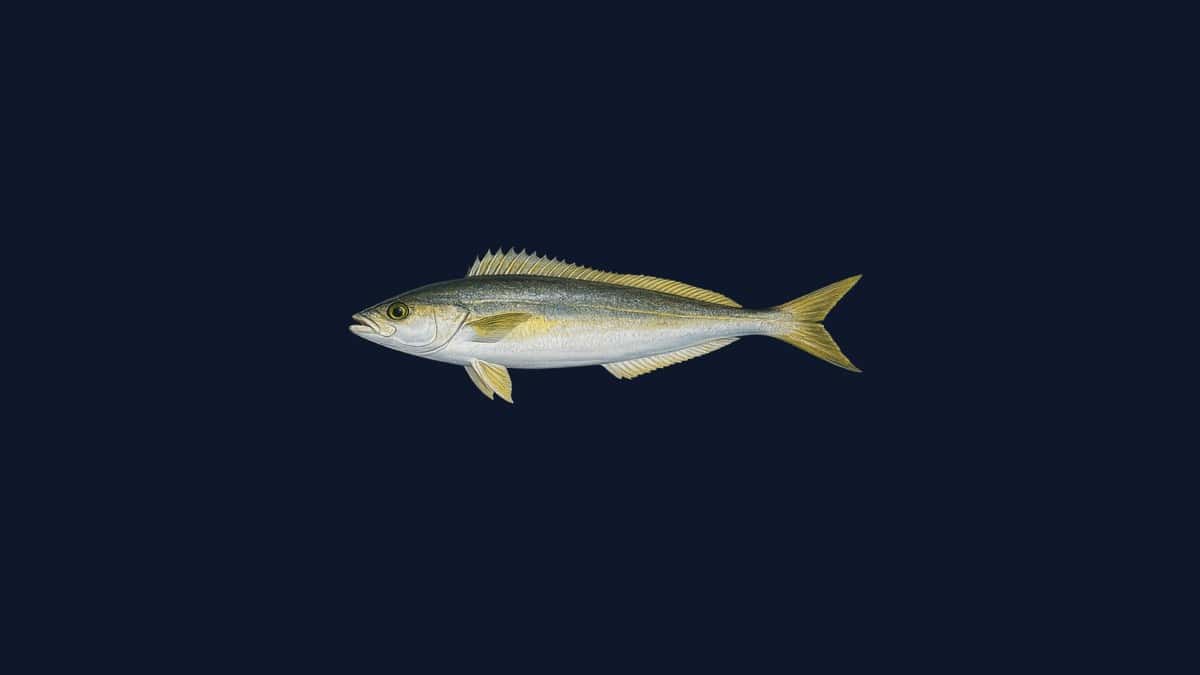
About Ocean Whitefish
Ocean whitefish (Caulolatilus princeps) is the fish that shows up in every trip report you read about San Diego half-day boats. Not the headline species, but always in the count: 20 calico bass, 14 sheephead, 30 ocean whitefish. They are consistent, they're willing biters, and they taste good. That combination makes them the backbone of the half-day fleet's mixed-bag experience.
Taxonomically, they're tilefishes — family Malacanthidae — the only tilefish species regularly encountered in California recreational fishing. FishBase documents them as far north as Vancouver Island but notes they're rare north of central California; the productive fishery is SoCal and the Channel Islands. The maximum size is 102 cm and 5.8 kg (nearly 13 lbs), though the typical catch is a fraction of that.
They live year-round on rocky reefs from 50 to 200 feet, which puts them squarely in the operating range of every half-day boat working coastal and island structure. Unlike rockfish, they don't require specific depth restrictions to target, and unlike calico bass, they're not subject to size minimums. They're as close to a no-complication, reliable target as exists in the SoCal reef fishery.
How to Catch
Dropper loops and shrimp flies. Ocean whitefish feed along the bottom around rocky structure and respond readily to cut squid. The standard SoCal technique is a two-hook dropper rig — either a dropper loop with cut squid chunks or a shrimp fly rig — baited and dropped to 60–120 ft of structure. The fish are schooling reef fish; if one bites, there are likely more.
Weight your rig to hold bottom in current — 4 to 8 oz depending on depth and drift speed. The bite tends to be tap-tap-thump; don't strike on the taps, wait for the thump and rod load, then reel. Circle hooks make this easier and result in cleaner hookups.
Drifting is more productive than anchoring. Covering ground lets you locate schools rather than waiting for fish to come to you. When you find a productive reef zone (usually 60–120 ft of structure adjacent to kelp), slow the drift and work it thoroughly.
Jigs work but require more effort — a 1–2 oz chrome jig bounced off bottom catches ocean whitefish on the drop and the retrieve. Good when fish are actively feeding higher in the water column.
Eating Profile
Genuinely good — one of the better-eating fish on a mixed half-day bag. The flesh is firm, white, mildly flavored, and holds together well in heat. It doesn't fall apart in fish tacos. It bakes cleanly with light seasoning. Fry it in a beer batter and it outperforms most rockfish.
Clean handling matters. Ocean whitefish on ice stay fresh for 24–36 hours. Fillets should be taken the same day if possible. There's no unusual spoilage concern, but as with all reef fish, keep them cold.
Common Mistakes
- Using too small a sinker. The dropper loop needs to be on the bottom, not suspended in the current column. Underweighted rigs catch kelp and debris; properly weighted rigs catch fish. Err on the heavier side.
- Setting the hook on the first tap. Ocean whitefish nose the bait. Wait for the weight. The circle hook will do the work if you let the fish commit.
- Fishing open sandy bottom. Ocean whitefish live on structure — rocky reef, boulder fields, kelp edges. Flat sand bottom produces almost nothing.
- Fishing too shallow. The most productive depths are 60–150 ft. The shallow reef zone (under 40 ft) is calico bass territory; deeper structure is whitefish and sheephead.
Month-by-Month
- Jan–Feb: Consistent bites year-round; winter brings fewer boats and often good bite density on productive reefs.
- Mar–Apr: Spring picks up. Channel Islands boats report reliable whitefish in the 60–120 ft zone.
- May–Jun: Ideal conditions. Half-day boats produce mixed bags with whitefish as a significant component.
- Jul–Aug: Peak season for the half-day fleet overall. Ocean whitefish are consistently present.
- Sep–Oct: Excellent fall action. Water temperature optimal; fish are aggressive.
- Nov–Dec: Still producing. Winter conditions can limit runs, but when boats go out, whitefish are caught.