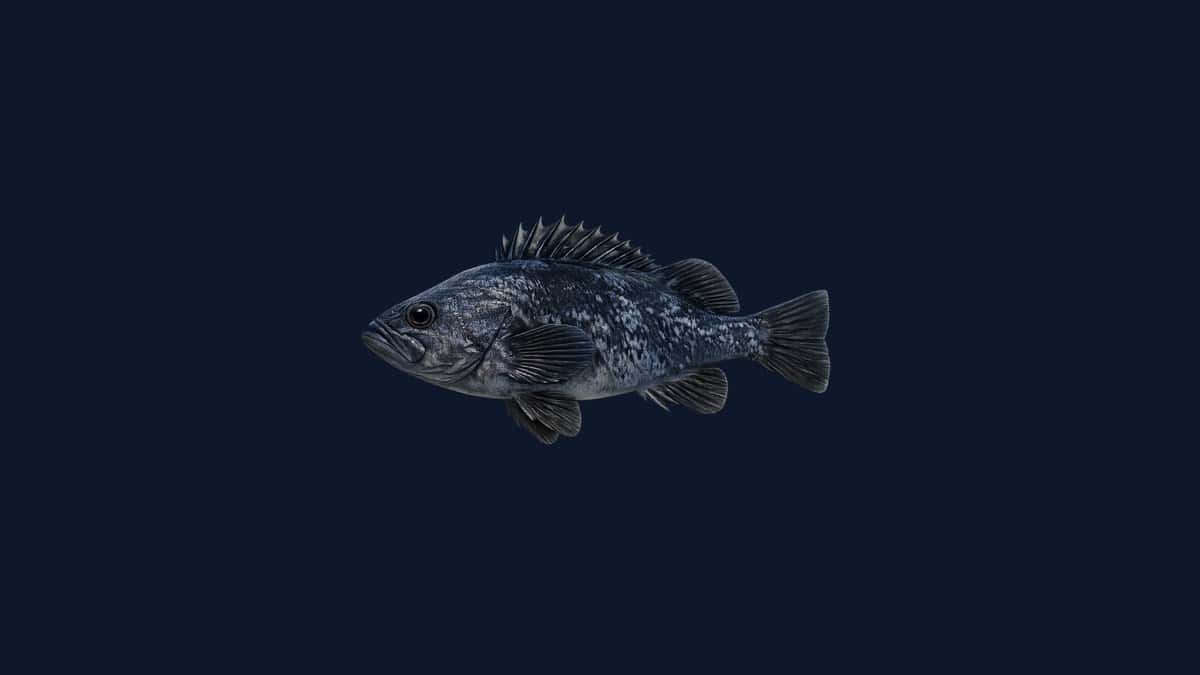
About Black Rockfish
Black rockfish are the NorCal rockfish. Where SoCal trips chase vermilion and bocaccio in 250–400 ft of water, NorCal boats work shallow rocky structure at 30–150 ft, and black rockfish are often the primary target.
Their dark grey-to-black body with pale mottling is distinctive. They're mid-water schoolers — not bottom huggers. Where most rockfish park on the reef and wait for bait to drift past, blacks actively chase krill, anchovies, and herring through the water column. That makes them more responsive to jigs and harder fighters on light tackle.
FishBase puts the max at 4.8 kg (~10.6 lbs); the California state record is 9 lbs 2 oz (San Francisco, 1988). A typical catch runs 1 to 4 lbs. A 6-pounder is a genuinely good fish.
How to Catch
Jigging is the NorCal standard. A 2–3 oz diamond jig or flat-fall dropped to a mid-water sonar mark and worked with short lifts is the most productive presentation in clear conditions. Blacks are aggressive — they don't need much coaxing. On days when they're active, you'll have hookups before the jig hits bottom.
Live bait works better when the fish are picky. Live mackerel or small live squid on a dropper loop at mid-depth will out-fish jigs when blacks are holding tight to structure and not chasing. The key is presenting it at the right depth — watch your sonar mark and match your bait position to where the fish are, not where the bottom is.
Cut squid on a dropper loop is the fallback when live bait isn't available. It's slower but reliable. Use a 6–10 oz sinker, drop to the reef, reel up two cranks, and wait.
Casting swimbaits near kelp edges works on private boats in 30–80 ft of water. A 4-inch Gulp mullet on a 1–2 oz jig head, worked with slow hops along the kelp edge, picks off blacks that are ambushing from the canopy margin.
Eating Profile
Black rockfish are good table fare — firm white flesh, mild flavor, holds together well in a pan or on the grill. Not quite as sweet as vermilion but better than a lot of the smaller rockfish species. Fillet and skin them like any rockfish. A 3-lb black gives you about 1.2 lbs of clean fillets.
Common Mistakes
- Fishing bottom instead of mid-water. Black rockfish aren't bottom huggers. If your sonar shows marks at 70 ft over 150 ft of water, fish at 70 ft. Anglers who reel up two cranks from bottom and stop are missing the school entirely.
- Too-heavy sinkers in shallow water. In 60 ft of water you don't need a 16-oz torpedo. Match sinker to the drift and depth — 4–8 oz is usually right for NorCal nearshore.
- Overlooking them on SoCal trips. If you're fishing Central Coast structure around Monterey or Morro Bay, blacks mix in with blues and browns regularly. They're often mistaken for blue rockfish. The tail margin is slightly indented on blacks (vs. rounded on blues) and blacks tend to be more uniformly dark.
Month-by-Month
- Jan–Mar: Groundfish closure in most boat-based areas. Shore access some areas.
- Apr: Opener. Blacks are hungry post-closure and responsive to jigs.
- May–Jun: Good fishing; NorCal upwelling brings baitfish and blacks follow.
- Jul–Sep: Peak season. Best average fish size of the year; mid-water schools active.
- Oct: Still producing; seas starting to build. Get trips in before weather turns.
- Nov–Dec: Weather limits access; when boats run, fish are present.