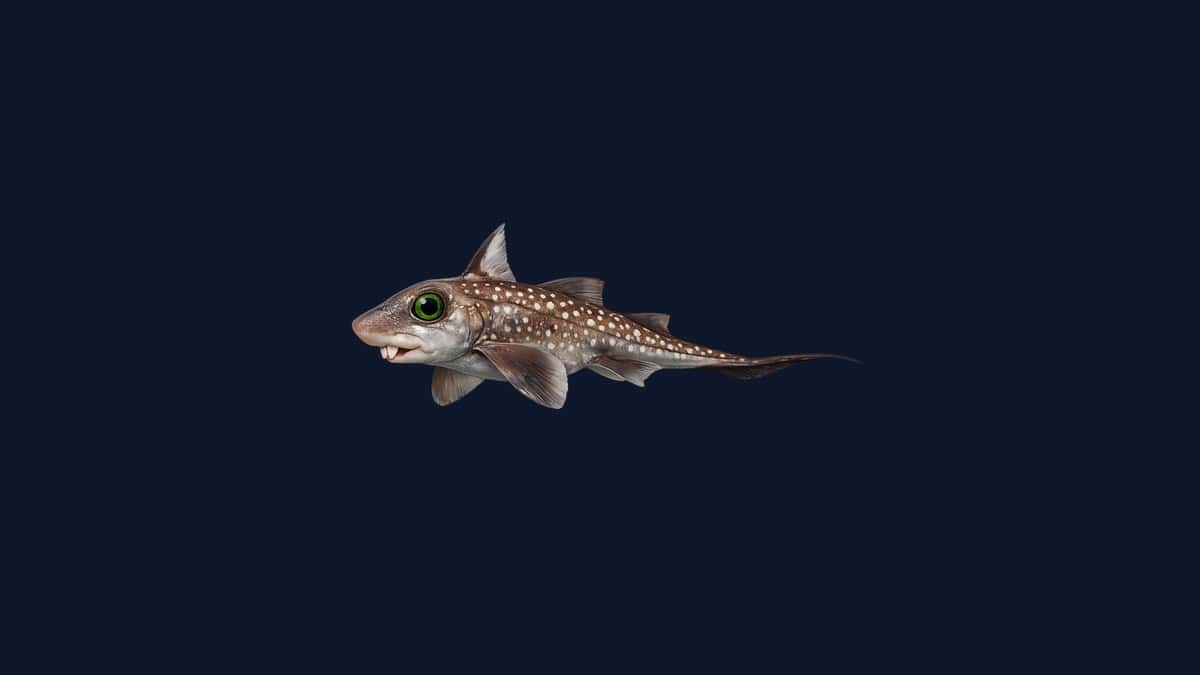
Spotted ratfish studio illustration — a chimaera with large eyes, silver-brown spotted body, a prominent venomous dorsal spine, and a long pointed tail against a dark blue background.
All Species

Spotted Ratfish

Hydrolagus colliei

Season: Year-round (more commonly encountered June–September on deepwater trips)1 lb – 5 lbs

Spotted ratfish (*Hydrolagus colliei*) are chimaeras — ancient cartilaginous fish that diverged from sharks and rays over 400 million years ago. They turn up as bycatch on deep-drop trips. VENOMOUS DORSAL SPINE — handle with care.

Illustration: Fish City

About Spotted Ratfish

Spotted ratfish (Hydrolagus colliei) are not related to rats, and they're not eels, and they're not a type of shark — though they're in the same class (Chondrichthyes, the cartilaginous fishes). They are chimaeras: a separate subclass (Holocephali) that diverged from the shark and ray lineage over 400 million years ago, before the first trees existed on land. They have fused tooth plates instead of individual teeth, a single opercular flap over the gills instead of multiple individual slits, and smooth iridescent skin instead of denticle-covered hide.

They're found throughout California coastal waters at 100 to 3,000 feet, with most recreational encounters at 100 to 500 feet over soft bottom. FishBase documents the maximum at 100 cm (about 40 inches). California catches typically run much smaller — 1 to 4 lbs is typical bycatch size.

Nobody targets ratfish. They come up on deep-drop rockfish or hake rigs and surprise the angler who pulls them to the surface and finds something they weren't expecting. The reaction is usually a double-take. That's fair — they look extraordinary.

How to Catch

Ratfish find your bait. They're benthic feeders on soft bottoms, using the lateral line system and electroreception to locate worms, clams, and small invertebrates. A baited dropper rig at 150–400 ft over sandy or muddy bottom will pick up ratfish if they're present. The bite is typically a slow, heavy pull — not the sharp bounce of a rockfish bite.

When you get one to the surface:

  1. Identify the dorsal spine immediately. It's the first spine on the first dorsal fin — typically 3–4 inches long, positioned prominently at the front of the fish. It's mildly venomous.
  2. Grip behind the head with a gloved hand or towel, avoiding the dorsal area.
  3. Use long-nose pliers to remove the hook.
  4. Release or keep — your choice. The fish doesn't get easier to handle over time.

Do not try to hold the fish by the tail — the elongated tail isn't structural for gripping.

Eating Profile

Edible, rarely kept. The flesh is white, mild, and lean — similar to other deep-water white-fleshed fish. Most California anglers release ratfish because they look alien and the fillet yield is modest. If you do keep one, dispatch quickly, ice immediately, fillet like a round fish (ignore the cartilaginous skeleton — it fillets the same as bony fish). Avoid the liver, which is not palatable. Pan-sear or bake; don't overthink it.

Common Mistakes

  • Grabbing the fish without looking first. The venomous dorsal spine is the first thing you need to locate before your hands go anywhere near the fish. Don't reach for it without looking.
  • Expecting it to fight like a rockfish. Ratfish are slow, deep-water animals. The fight is heavy with current resistance but not dramatic. They don't sprint or run.
  • Assuming it's a shark. The body shape causes occasional confusion — it's cartilaginous, pointed tail, smooth skin. But the rabbit-like face, fused tooth plates, enormous eyes, and smooth opercular flap identify it immediately as a chimaera.
  • Not having pliers ready. Always have pliers at hand on a deep-drop trip. If you're not prepared for hook removal without bare-hand contact, a ratfish encounter becomes awkward fast.

Month-by-Month

  • Jan–May: Present year-round at depth; less commonly encountered as fewer anglers run deep-drop trips in winter.
  • Jun–Jul: Deep-drop season picks up. Ratfish encounters increase with fishing pressure at 150–400 ft.
  • Aug–Sep: Peak encounter season; most deep-water trips cover soft-bottom areas where ratfish occur.
  • Oct–Nov: Still producing on deep-water rockfish trips; weather increasingly limits access.
  • Dec: Rare encounters; deep-water conditions deteriorate for recreational fishing.

Where to Catch Spotted Ratfish in California

  • Soft bottom (sandy, muddy) at 100–500 ft depth along the entire California coast
  • Common bycatch on deep rockfish and sablefish trips throughout the state
  • Channel Islands deep areas (SoCal)
  • NorCal and Central Coast offshore soft bottom
  • Rarely seen at the surface — a deep-drop encounter

Conditions & Habitat

Water Temp

40–50°F; deep cold-water species

Typical Depth

100–3,000 ft (FishBase: usually 50–400 m); most recreational encounters at 100–500 ft on soft bottom

Diet

Clams, worms, shrimp, small fish, amphipods — deep benthic feeder with fused tooth plates that function like a beak

How to Catch Spotted Ratfish

Techniques

  • Bycatch only — not targeted by recreational anglers
  • Shows up on deep-drop baited rigs at 100–500 ft over soft bottom
  • Bite feels unusual: slow, heavy pull without the typical rockfish bounce
  • HANDLING: immediately identify the dorsal spine before touching the fish — it's the first spine on the first dorsal fin, typically 3–4 inches long
  • Grip the fish behind the head with a gloved hand, avoiding the dorsal area; use long-nose pliers to remove the hook
  • Release or keep — if keeping, dispatch quickly and immediately ice

Line & Leader

Same deep-drop setup used for rockfish or hake works — 20–30 lb braid, 20–30 lb fluorocarbon leader, 4–8 oz sinker, 3/0–4/0 circle hook. The ratfish finds your bait; you're not targeting it.

Rod & Reel Combos

  • Same rod/reel setup used for deep rockfish or hake — conventional gear with 20–30 lb braid

Regulations

Spotted ratfish are classified as finfish in California and fall under the general ocean finfish daily bag limit: 20 finfish in combination of all species, with no more than 10 of any one species (14 CCR § 27.60). There are no species-specific regulations, minimum size, or closed season for ratfish. Note: the venomous dorsal spine is a handling concern, not a regulatory one — handle carefully regardless of whether you plan to keep or release the fish. Always verify current CDFW regulations.

As of April 20, 2026 — CDFW source

Did You Know?

Spotted ratfish eggs are encased in a leathery egg case (a 'mermaid's purse' like many shark species) but ratfish egg cases are distinctive: elongated, olive-brown, with long filamentous extensions at each end that anchor the case to the sea floor. A ratfish takes roughly 12 months to develop from egg to hatching — an unusually long incubation for a fish. The skin was historically used as sandpaper and sold commercially as 'shagreen.'

Book a Spotted Ratfish Charter

Find charter boats targeting Spotted Ratfish at these California landings:

Frequently Asked Questions

Yes. The first spine on the first dorsal fin is a mildly venomous spine. A puncture wound from the spine causes localized pain and swelling — not life-threatening to a healthy adult, but genuinely painful and capable of causing infection if not cleaned properly. FishBase notes that some fishers fear the jaws more than the spine; both are hazards. The solution is simple: identify the spine before touching the fish, grip behind the head with a gloved hand, and use pliers for hook removal.

Sources

Ready to Find the Bite?

Join thousands of California anglers using Fish City for real-time fish counts, reports, and charter data.

Download on the App StoreGet it on Google Play

Free — no subscription required