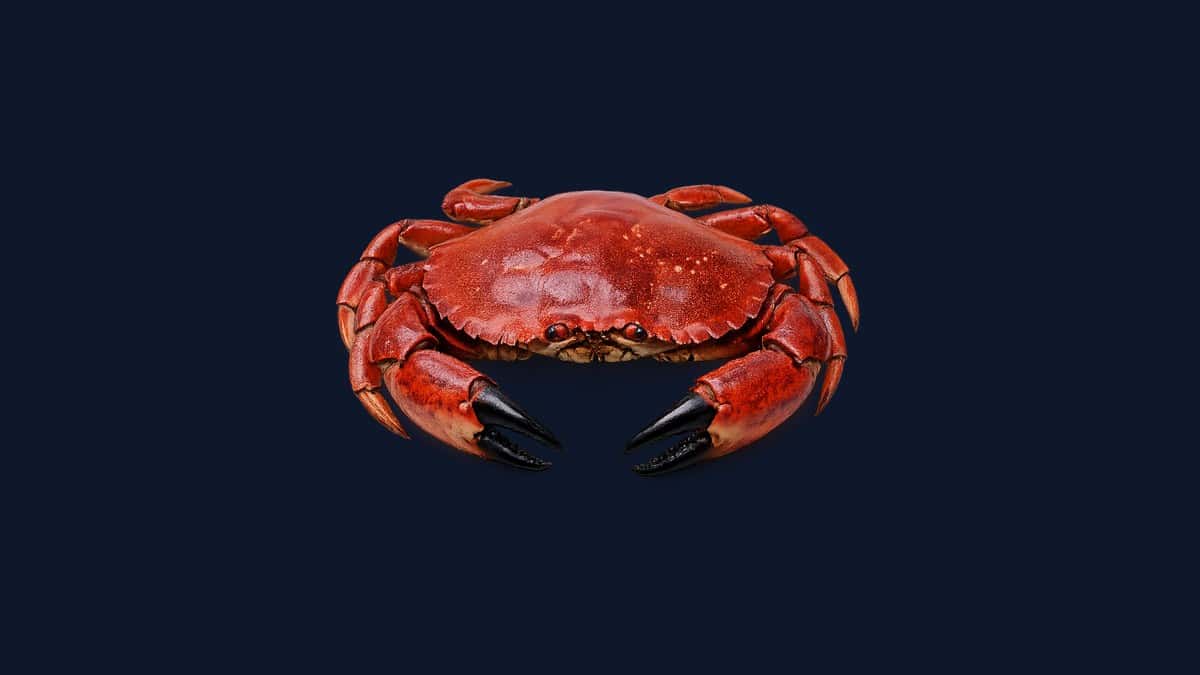
Red rock crab studio illustration — brick-red carapace with black-tipped pincers against a dark rocky background.
All Species

Red Rock Crab

Cancer productus

In Season Now4 oz – 1.5 lbs

The rocky-reef crab with black-tipped pincers. Cancer productus lives in tidepools and rocky subtidal from Alaska to Baja. Smaller than Dungeness, more aggressive, and open year-round under 14 CCR § 29.85.

Illustration: Fish City

About Red Rock Crab

Red rock crab (Cancer productus) is the archetypal California rocky-shore crab. They live everywhere there are wet rocks and cold water — from Alaska to central Baja, intertidal to subtidal, pier pilings to kelp holdfasts. A legal-size red rock crab runs 4 to 6 inches across the carapace and weighs 8 oz to 1.5 lbs. They're much smaller than Dungeness but much easier to find — you don't need a boat, you don't need a pot soak, you don't need a permit validation. You need a gauge and a willingness to get your hands wet.

They're also genuinely aggressive. The black-tipped pincers are strong and they'll draw blood if you handle them carelessly. A red rock crab cornered in a tidepool will fight. That's useful to know before you reach under a rock.

They're in genus Cancer — which, unusually, still applies after the 2007 taxonomic split that moved yellow crab, brown rock crab, and Dungeness out of Cancer. Red rock crab is now one of the few California rock crabs whose scientific genus still matches the regulatory "Cancer genus" language in § 29.85.

How to Catch

Three approaches: hoop net, crab snare, hand collection.

Hoop net from a boat or pier in 5–50 feet over rocky bottom. Squid, mackerel, or sardine carcass in the bait box. 30–60 minute soak. Works well at Pillar Point, Avila, Monterey, and along the SoCal rocky coast when you drop on the right bottom structure. Red rock crabs are faster to the bait than Dungeness and will stack up quickly on the net.

Crab snare from a pier or jetty is the cheap, bankless approach. Same setup as Dungeness snares — 4–6 oz pyramid sinker with loops of mono, bait in the middle, cast, wait, yank. Shorter casts work for rock crabs because they're closer to shore. Pacifica Pier, Avila Pier, Stearns Wharf, and Redondo Beach Pier all produce.

Hand collection at low tide is the purist approach. Walk tidepool edges at minus tides; flip rocks (put them back); gauge crabs in-situ. Gloves mandatory — the pincers will get you. Know the MPA rules for your location. Many California tidepools are inside no-take MPAs. Take is legal at beaches outside MPA boundaries subject to the 4-inch / 35-bag rule (except Districts 8 and 9, where no size minimum applies).

Eating Profile

Better than their reputation suggests. Red rock crab meat is sweet, dense, and richer than Dungeness — probably because they eat more mussels and barnacles. The yield per crab is low (a 4-inch crab produces ~2 oz of picked meat), so a meaningful meal takes 10+ crabs.

Cooking: boil or steam in salted water 6–8 minutes, shock in ice water, crack shells, pick meat. The legs are fiddly because they're small but hold the best meat. Body meat is also good; claw meat is the densest and sweetest — save those for last.

Don't discard the shells — red rock crab shells make some of the best crab stock for bisque or paella on the West Coast. Simmer 45 minutes with onion, carrot, celery, tomato, and fennel.

Common Mistakes

  • No gauge. The 4-inch minimum matters outside Districts 8/9. "Looks big enough" isn't a legal defense.
  • Taking from no-take MPAs. Tidepools inside marine reserves are closed to all take. Check the map before you flip a single rock.
  • Bare hands. Black-tipped pincers cut skin. Use gloves.
  • Mixing red rock and brown rock counts. The 35-bag is COMBINED across non-Dungeness Cancer crabs (and Dungeness has its own separate 10-bag). Track your total.
  • Missing the Districts 8/9 carve-out. If you're in SF Bay or San Pablo Bay, you don't need the 4-inch minimum — but you still have the 35-bag. Don't apply coastal rules to inland bay waters and vice versa.

Month-by-Month

  • Year-round legal. Open all 12 months under § 29.85(c).
  • Jan–Mar: Dungeness overlap season. Red rock crab available but most crabbers focus on Dungeness when that fishery is open.
  • Apr–Jun: Dungeness season winding down (closes June 30 in most counties). Red rock crab starts becoming the primary target for California crabbers.
  • Jul–Sep: Peak effort period. Dungeness is closed (except Del Norte/Humboldt/Mendocino through July 30). Red rock crab (and spider/sheep crab, and brown rock crab) carry the summer crabbing season.
  • Oct: Continues strong. Water still warm enough for comfortable tidepool and pier work.
  • Nov–Dec: Dungeness reopens first Saturday of November and takes over attention. Red rock crab remains legal and available; many anglers still target them in rocky areas where pots are restricted for whale protection.


Where to Catch Red Rock Crab in California

  • Rocky intertidal and subtidal throughout California (Alaska to Baja range)
  • Tidepools at low tide — visible under rocks and in crevices
  • Channel Islands and Palos Verdes rocky shoreline
  • Monterey Peninsula and Central Coast rocky points
  • NorCal rocky intertidal — Mendocino, Humboldt, Sonoma coast
  • Pier pilings and jetties where rocks meet the subtidal

Conditions & Habitat

Water Temp

50–62°F; tolerates tidepool temperature swings

Typical Depth

Intertidal to ~260 ft; most recreational take in tidepools and subtidal 0–80 ft on rocky bottom

Diet

Barnacles, mussels, small crabs, worms, carrion — intertidal and subtidal scavenger; known to eat other crabs

How to Catch Red Rock Crab

Techniques

  • Hoop net in 5–50 ft baited with squid or fish carcass over rocky bottom
  • Hand collection at low tide in tidepools and rock crevices (check MPA rules before taking)
  • Crab snare from pier or jetty — same rig as Dungeness, shorter cast distances
  • Measure with a gauge — 4-inch carapace width minimum (except Fish and Game Districts 8 and 9, where no minimum applies)
  • Watch the pincers — black-tipped claws are strong and they will draw blood

Lures & Baits

  • Hoop net (collapsible 30-inch) with bait box — works for rock crabs in rocky bottom areas
  • Crab snare with 4–6 oz surf sinker — pier and jetty technique
  • Bait: squid, mackerel carcass, sardine, bonito chunk — any oily fish scrap
  • Dip net / crab hook for tidepool hand collection

Line & Leader

Hoop nets: 50–100 ft of 3/8-inch rope to marked surface buoy. Snares: 40 lb braid on a surf rod.

Rod & Reel Combos

  • Pier snare: 10 ft surf rod + 4000-size spinning or 6500 conventional, 40 lb braid
  • Boat hoop-net: hand-pulled rope and buoy — no rod needed
  • Tidepool: no tackle, but waterproof gloves mandatory (black pincer tips cut hands)

Regulations

Red rock crab (*Cancer productus*) falls under 14 CCR § 29.85(c), which covers 'all crabs of the Cancer genus except Dungeness crabs.' Daily bag limit: **35 crabs** combined across all non-Dungeness Cancer species (red rock crab, brown rock crab, yellow crab, slender crab). Minimum size: **4 inches carapace width**, measured as the shortest distance through the body from edge of shell to edge of shell at the widest part — **except there is no minimum size in Fish and Game Districts 8 and 9**. Season: **year-round**. Legal methods (§ 29.80): hoop net, crab trap (with Recreational Crab Trap Validation), crab snare, hand, skin- or SCUBA-dive. SCUBA take of Cancer-genus crabs is permitted both north and south of Yankee Point (the standard SCUBA invertebrate restriction in § 29.05 carves out crabs of the Cancer genus).

As of April 20, 2026 — CDFW source

Did You Know?

*Cancer productus* is one of the few members of the genus *Cancer* that wasn't reclassified in the 2007 revision — yellow crab (*Metacarcinus anthonyi*), brown rock crab (*Romaleon antennarium*), and Dungeness (*Metacarcinus magister*) all moved out of *Cancer*. Red rock crab stayed. So it's now one of the few California 'rock crabs' whose genus name matches the common regulatory grouping.

Book a Red Rock Crab Charter

Find charter boats targeting Red Rock Crab at these California landings:

Frequently Asked Questions

Size and appearance. Dungeness (*Metacarcinus magister*) is much larger — a legal Dungeness is 5¾ inches minimum and commonly hits 3 lbs; a legal red rock crab is 4 inches minimum and typically runs under 1 lb. Red rock crabs have distinctive **black-tipped pincers** and a brick-red to purplish carapace; Dungeness have pale-tipped pincers and a tan-to-orange carapace. Dungeness live on sandy/muddy bottom; red rock crabs live on rocky bottom and in tidepools. Dungeness season closes June 30 in most counties; red rock crab is year-round.

Sources

Ready to Find the Bite?

Join thousands of California anglers using Fish City for real-time fish counts, reports, and charter data.

Download on the App StoreGet it on Google Play

Free — no subscription required