About Spider Crab
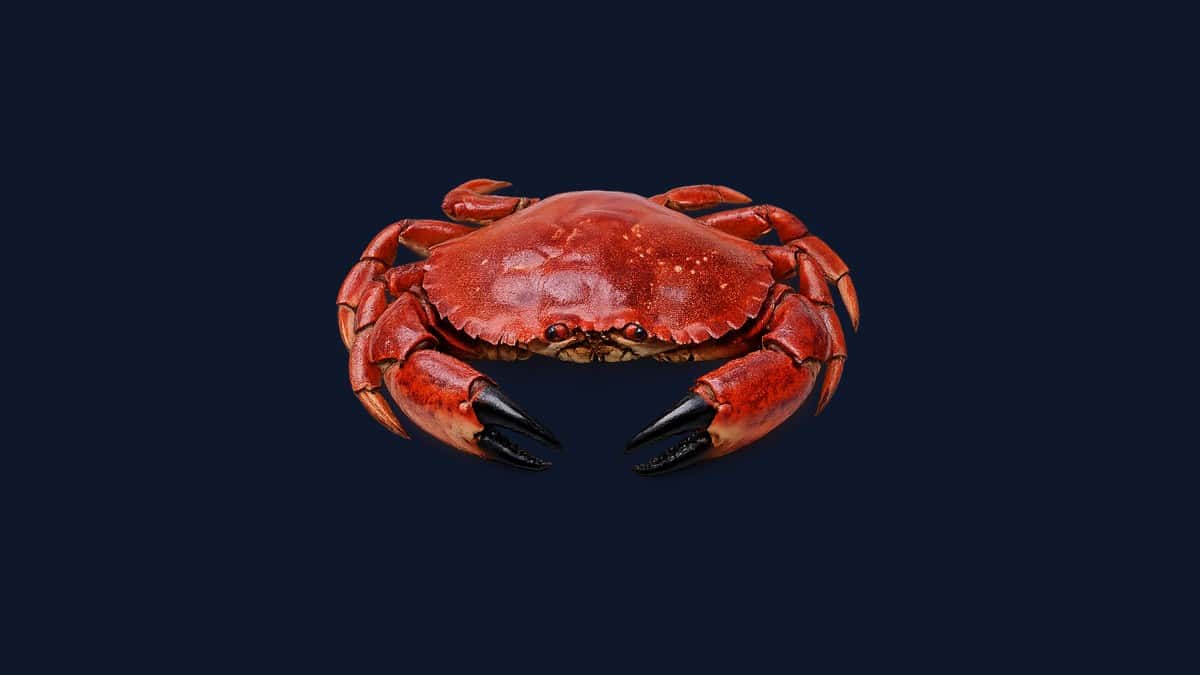
Spider crab (Loxorhynchus grandis) — also called sheep crab, occasionally California king crab — is a majoid crab (family Epialtidae, the "decorator crabs") that lives on mixed bottom throughout SoCal and central California. A mature adult has a carapace 8 to 10 inches across and a leg span approaching 3 feet. They weigh 3 to 8 lbs. Females are smaller than males.
They are not a Cancer crab. This matters regulatorily. Rock crabs (red, brown, yellow, slender) are all in or near genus Cancer and regulated under § 29.85(c). Spider crabs are in Loxorhynchus, family Epialtidae — a completely separate crab lineage. Because they're not mentioned by name in § 29.85, § 29.90, or any species-specific regulation, they default to the § 29.05 general invertebrate rules: 35 per day, no size minimum, year-round, with MPA and SCUBA restrictions.
Morphologically, the long legs are diagnostic. No other California crab has leg-to-body ratio like a spider crab. Juveniles decorate their carapace with sponges, algae, and bryozoans — the decoration serves as camouflage and reaches peak complexity in small individuals. Adult males groom smooth; adult females retain some decoration. That variability explains why a boatload of spider crabs can look like multiple species on first glance.
How to Catch
Spider crabs are almost always caught incidentally on lobster hoop nets, Dungeness pots, or rock crab traps. Target fishing for them is unusual because they move slowly and are distributed across mixed bottom that anglers are usually soaking for another species. But when they show up, they're legal, year-round, no-minimum — so keep them if you want.
Hoop net is the primary method. Same rig as lobster and rock crab: 30-inch collapsible net, bait box with squid/mackerel/salmon skins, 45–90 minute soaks in 30 to 200 feet over mixed rock/sand. Spider crabs walk to the bait slowly, don't leave quickly, and often stack multiple per pull.
Crab trap with Recreational Crab Trap Validation extends the soak. Spider crabs enter and don't leave; they're slow.
Freedive in SoCal kelp forests produces spider crabs if you're looking for them. Adults often den under ledges or in kelp-holdfast labyrinths. Tickle stick to coax them out, gloved hands on the carapace (not the legs — autotomy).
SCUBA restrictions. South of Yankee Point (Monterey County), SCUBA hand-capture of spider crab is legal. North of Yankee Point, § 29.05 restricts SCUBA invertebrate take to urchins, rock scallops, and Cancer-genus crabs — spider crabs don't qualify. Freedive is legal statewide.
Handle by carapace only. Legs are fragile and the crab will drop them to escape. A leg-handled spider crab often ends up as just a leg.
Eating Profile
The long legs are the point. White, sweet leg meat that's closer in texture to snow crab than Dungeness — flaky, pull-apart, delicate. Body meat is sparse and typically not worth picking. A 3-lb spider crab produces about 6 oz of leg meat; a 5-lb one produces 10 oz.
Cooking: boil or steam 12–15 minutes (longer than Dungeness because the legs are thick and the shell is heavier). Shock in ice water. Crack legs with kitchen shears or a nutcracker. Serve with butter.
Spider crab is probably the single best California crab for pure leg-meat consumption. If you can get 5–8 of them, you have a meal that stands up to any snow crab feed.
Common Mistakes
- Assuming they're in the 35-bag Cancer limit. They're NOT. Spider crab is a separate § 29.05 invertebrate. However, the practical bag ends up looking the same (35/day).
- SCUBA-taking north of Yankee Point. Illegal for non-Cancer crabs under § 29.05. Freedive or hoop-net only in NorCal.
- Handling by the legs. Autotomy. The legs break off. Handle by the carapace.
- Cooking like Dungeness (8–10 minutes). Too short for spider crab — shell is thicker. 12 to 15 minutes.
- Discarding because "not a real crab." Genuinely excellent eating. Many who've tried both prefer spider crab leg meat to Dungeness body meat.
- Ignoring MPA boundaries. No-take MPAs apply to all invertebrates including spider crab. Check the map before dropping gear.
Month-by-Month
- Year-round legal under § 29.05 (no closed season).
- Jan–Mar: Available but most effort is on Dungeness and lobster. Spider crab mostly incidental catch.
- Apr–Jun: Dungeness winding down, lobster already closed (spring). Spider crab continues as incidental catch and begins to be a dedicated target for SoCal crabbers.
- Jul–Sep: Peak effort period. Dungeness closed everywhere, rock crabs and spider crabs carry summer. Hoop net trips specifically for spider crab pick up.
- Oct–Dec: Lobster season opens October 2, 2026 — most Southland diver/angler effort shifts to lobster. Spider crab continues as incidental catch on lobster hoop nets. Plenty come up; keep what you want up to the 35/day.