About Wolf Eel
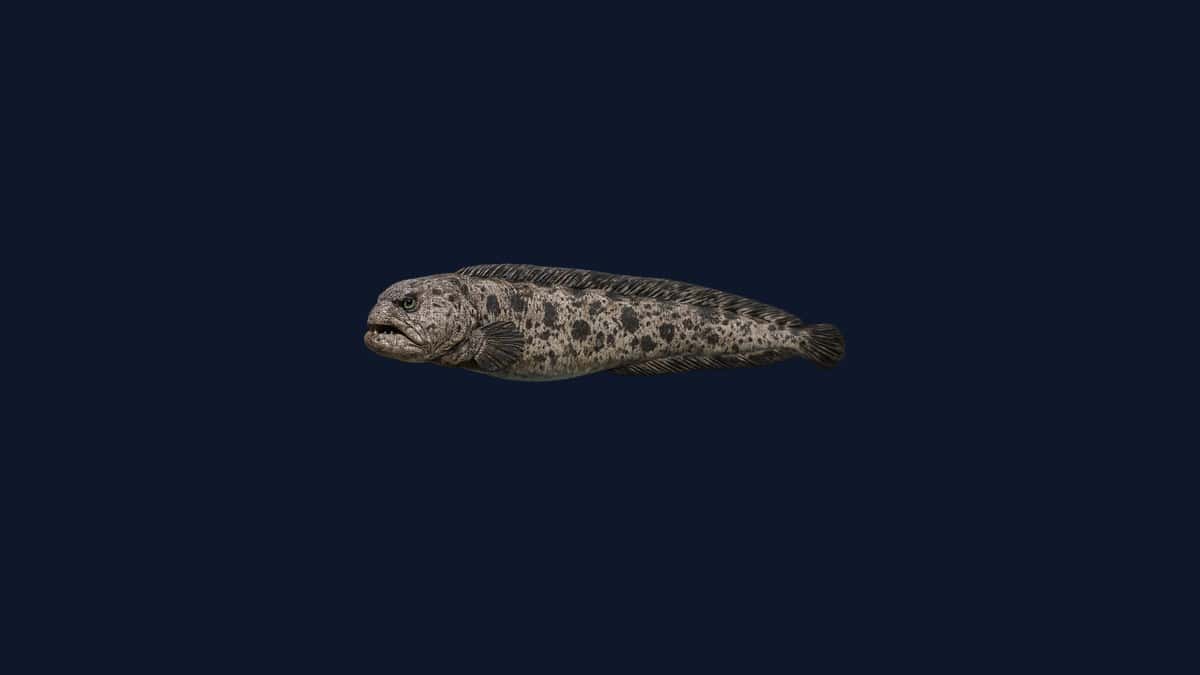
Wolf eels (Anarrhichthys ocellatus) look like something you'd find in a nightmare about deep-sea fauna. They're not. They're timid, cave-dwelling, monogamous fish with enormous heads, serpentine bodies, and the kind of teeth that could bite through a Dungeness crab shell — which they regularly do. Despite that equipment, divers who've spent time around them describe them as curious and habituatable, not aggressive.
They're not a true eel — they're family Anarhichadidae, the wolf-fish family, more closely related to blennies than to eels. The body shape is convergent: life in rocky crevices selects for long, flexible forms whether or not the animal is biologically an eel. FishBase documents the maximum size at 240 cm (nearly 8 feet) and 18.4 kg (about 40 lbs). California catches average much smaller — 2 to 8 lbs is typical for recreational bycatch.
In the fishing context, wolf eels are bycatch. They're not anyone's primary target. You're fishing for rockfish or lingcod on a rocky reef, and one comes up on your bait. The reaction ranges from surprise to genuine excitement — they're unusual, they look extraordinary, and if you keep them, they eat well.
How to Catch (When You're Not Trying To)
Wolf eels come up on bottom-fishing rigs baited with squid, mackerel, or crab near rocky structure. There's no particular technique — they find the bait in their cave or crevice and take it. The hook-set isn't dramatic; the fish pulls heavily but doesn't sprint. It'll try to gain depth and wedge back into a crevice, so maintain tension.
If you're specifically trying to target wolf eels (unusual, but possible), use a live small crab or sea urchin on a 4/0 hook dropped near cave openings in rocky reef structure. Leave it still for 5–10 minutes before moving. Wolf eels are ambush feeders and won't chase; they need the bait to come to them.
Handling warning: Use a towel or fish rag to grip the fish. Long-nose pliers for hook removal. Do not put fingers near the mouth. The crushing teeth can cause serious injury. The fish is not trying to bite you — but the bite reflex will fire if you put something near those teeth.
Eating Profile
Genuinely one of the better reef fish. White, fine-grained, firm flesh that holds up well to heat. The texture is closer to halibut than to rockfish — less flaky, more substantial. Pan-sear with oil and garlic; bake in foil with lemon; the result is clean and mild. Fillet yield per fish is good for the size.
Don't try to prepare it eel-style (smoked, braised) — wolf eel isn't an eel and doesn't benefit from those techniques. Treat it like a high-quality white reef fish.
Common Mistakes
- Not controlling the fish on the way up. A wolf eel given slack on the retrieve will wedge into the first crevice it reaches. Keep tension throughout the fight.
- Grabbing the fish bare-handed. Use a towel. The teeth are a genuine hazard and the fish is slippery.
- Assuming it's not worth keeping. Wolf eel meat is excellent. If you're keeping fish, this one earns a spot.
- Confusing it with a moray eel. Moray eels (Gymnothorax) are occasionally encountered in SoCal; wolf eels are more common in Central/NorCal. Wolf eels have pectoral fins (moray eels don't), visible scales, and a spotted pattern (ocellated). Morays have smooth, scaleless skin and typically a more aggressive disposition.
Month-by-Month
- Jan–Apr: Present in deep rocky structure year-round, but less commonly encountered as boat traffic decreases.
- May–Jun: Rocky reef trips pick up; wolf eel bycatch increases with fishing pressure on reefs.
- Jul–Sep: Peak encounter season for Central and NorCal rocky bottom fishing.
- Oct–Nov: Still producing on deep reef structure; weather increasingly limits boat access.
- Dec: Rare encounters; fish are in caves through winter.